A ransomware affiliate calling itself Ransom Busters has been spotted proactively sending emails to victim organizations and claims to delete stolen data from ransomware groups' servers in exchange for a fee ranging from $20,000 to $60,000. "In these messages, the third-party offers to help the victim recover from ransomware attack. This immediately stands out as anomalous," GuidePoint Research
Traveling electrical waves sweeping across the brain may help determine what we notice, predict what comes next, and construct our internal picture of the world. Researchers now argue that these waves aren't just background activity—they could be a core computational engine behind perception and memory.
Disney superfan Toni Kulusich has been accused of stalking her favorite character, sparking discourse about boundaries with park actors. She tells WIRED the backlash is unfair.
Enterprises that already got burned by an AI agent passing its evals and then failing in production are moving faster toward removing humans from deployment decisions, not slower — even as trust in automated evaluation is rising across the board, new VB Pulse research shows . In July, 13% of 108 enterprises surveyed said they trust automated evaluation, up from just 5% the month prior . Meanwhile, survey respondents citing poor alignment between tests and real-world results as their biggest concern fell 10 points, from 29% to 19%, month over month. Yet, 49% of survey respondents said that an AI agent or LLM-powered feature that had cleared company testing subsequently created a problem visible to customers , essentially unchanged from 50% in June. And nearly a quarter, 24%, said this troubling outcome had occurred more than once. The latest findings from VentureBeat Intelligence uncovered a more troubling phase of the enterprise agent rollout: the gap is no longer only between how much autonomy companies give agents and how well they can verify them. It is increasingly a gap between confidence in the evaluation layer and evidence that the layer is getting better at preventing failures. The most revealing split appears inside the July data. Of the enterprises that experienced an AI feature clear testing only to go on to disappoint a customer, 4% placed complete faith in automated checks. Of those that had detected no comparable incident, 24% expressed full confidence — a sixfold difference. It makes sense: those who experienced test-passing agents failing in live production are, unsurprisingly, more likely to doubt the automated checking process. Perhaps it makes sense then, that companies geared toward tackling this problem — like automated agent error monitoring and mitigation platform Raindrop.ai — are seeing the market transform wildly from just a few months ago. "We are seeing the great-decline of evals as we know them," Raindrop CTO Ben Hylak told VentureBeat in a direct message. "The Fortune 100 are increasingly reducing eval sets and deprioritizing maintenance. As systems grow more complex (MCPs, subagents, etc.) it becomes impossible to fully enumerate the failure cases. Instead, they’re leaning on anomaly and issue detection solutions, both before and after production." A directional finding, not a market census VentureBeat fielded the July wave among 108 people representing companies with workforces of at least 100. This is down from 157 respondents in June. Of the 108, 69% described themselves as final AI-buying authorities or people who recommend and influence those purchases. The sample skewed toward midsize organizations: 63% worked at companies with 100 to 2,499 employees. The findings should be read directionally. The survey is self-selected rather than a probability sample, and the burned-vs.-unburned splits cited throughout this piece rest on groups of 41 to 53 respondents, and other cross-tabs in the report range from 40 to 68. The industry mix also changed: technology and software participation declined nine points, ending at 14%, while the retail and consumer share added four points and ended at 19%. The report nevertheless identifies four month-to-month changes worth noticing: more respondents professing complete confidence, fewer naming poor real-world alignment, more choosing integration ease as the decisive buying factor, and Braintrust gaining primary-platform share. Confidence in automated evals improved, but outcomes stayed flat VentureBeat's June research identified an enterprise evaluation gap : companies were granting agents more authority faster than they were developing reliable ways to test them. July preserves the key number from that first wave. Across 265 enterprise responses over the two months, the proportion reporting at least one test-approved system that disappointed customers stayed within a single percentage point : 50% in June and 49% in July. This figure does not mean that 49% of all agent runs fail, or that any particular evaluation product has a 49% failure rate. The survey asks whether an organization experienced at least one customer-facing incident in the previous year after an AI feature passed its internal tests. Companies that deploy far more agents have more opportunities to encounter such an incident. But that limitation does not make the result less important. An internal evaluation serves as a release gate. If roughly half of surveyed organizations have seen that gate approve a system that later fails in front of customers, a passing score cannot be treated as proof of production reliability. The cross-tab reinforces the point. Ten of the 41 enterprises with no identified testing miss placed complete faith in automation. Only two of the 53 previously burned enterprises said the same. Confidence is strongest among respondents with the least evidence that the release gate can fail. The enterprises that got burned are moving faster toward zero-human deployment The counterintuitive finding is what companies do after an evaluation miss. Overall, 67% either let an agent push code or change a system without a person's approval in certain low-risk cases, or are modifying their pipelines to support that practice during the coming year . That is unchanged from June. In July, 37% already permitted it in limited cases and another 30% were building toward it. Among enterprises where a test-approved system had disappointed a customer, however, 85% were pursuing that no-approval model , compared with 61% in the group reporting no comparable incident. Only 11% of burned respondents rejected end-to-end deployment automation for the years ahead, versus 24% of unburned respondents. It would be easy to read that as recklessness, but the data supports another plausible explanation: deployment maturity. Organizations running more agents, at higher volume and across more consequential workflows, are more likely both to encounter failures and to have the engineering infrastructure needed for automated deployment. The survey cannot establish which explanation dominates. It does establish that a customer-visible incident does not appear to stop the move toward autonomy. Respondents with firsthand proof that testing can miss defects are also moving most aggressively to let those tests authorize production changes. If their per-deployment failure rate remains constant while deployment volume rises, the total incident count could grow even without the percentage of affected companies increasing. The July data does not measure incident volume, so that remains a risk implied by the pattern rather than a measured outcome. The release gate is automated, but production quality monitoring still lags Pre-deployment evaluation and production monitoring answer different questions. An evaluation asks whether an agent appears ready to ship. Production monitoring asks what the agent is doing after release and whether its live outputs remain correct. Most companies in the July sample still emphasize whether the system functions, not whether the answer is correct. Among the 106 valid responses to this question, 26% used inline quality assertions — automated judges or guardrails checking live traffic for output-quality problems. Another 26% focused on transaction traces such as infrastructure spans, token usage and raw inputs and outputs, while 24% mainly tracked gateway metrics such as latency, errors and cost. Trace and gateway data can reveal outages, slowdowns and broken requests. They may not flag a fluent, fast and confidently wrong answer. Grouped by the report according to what each architecture actually watches, half of respondents monitored whether an agent was functioning, while just over a quarter automatically monitored whether its production output was correct. The gap is sharpest among the 40 respondents already permitting no-approval deployment in limited cases. Only 28% of that group automatically checked the meaning and correctness of live answers . In other words, most enterprises that have eliminated a person from at least some release decisions have not installed automated semantic-quality monitoring as the production backstop. This is the clearest operational lesson in the data. A pre-deployment test suite and infrastructure observability are necessary, but they do not cover the same failure mode. Enterprises need a way to detect bad outputs after the agent begins interacting with real users, data and tools — especially when nobody reviews the deployment decision first. An independent agent-evaluation market begins to take shape The vendor data offers a more encouraging sign: enterprises are adding dedicated evaluation tools, and specialist platforms are gaining ground. OpenAI's native evals and traces narrowly led as the primary platform at 18%, followed by Confident AI's DeepEval at 17% and Braintrust at 15% . Anthropic's Claude Console and Workbench held 12%, tied with organizations reporting no dedicated evaluation platform. Three options each held 6%: internally built tools, Promptfoo and LangSmith. Braintrust's primary share increased from 8% in June to 15% in July, the biggest gain by one vendor and the one the report flags as statistically significant. DeepEval rose from 12% to 17%. Use of no purpose-built platform declined five points to 12%, although that smaller change does not by itself confirm a trend. Because many companies use more than one tool, the broader footprints are larger. OpenAI native evaluation appeared somewhere in 31% of stacks, DeepEval in 27%, Braintrust in 22% and Anthropic's native tooling in 20%. Custom internal tooling reached 14%, while Weights & Biases Weave and open-source Langfuse each reached 11%. These are adoption figures, not product-performance scores. The survey does not establish that one vendor produces more reliable agents than another. Still, the results point toward evaluation becoming a distinct enterprise software layer rather than a loose collection of internal scripts or a feature used only inside a model provider's platform. Purchasing priorities are changing with that market. The proportion choosing integration ease as the decisive factor climbed 12 points to 39% , displacing cost, which fell from 28% to 23%. Evaluation accuracy ranked second at 28%. The combined average for satisfaction, implementation simplicity and economic value was 3.9 out of five. The move from price toward integration suggests enterprises increasingly want a tool they can install into existing development and monitoring pipelines now. Yet their leading success metric remains evaluation consistency at 38%, followed by fewer failures and regressions at 20%. Buyers are selecting for fit while still judging results on repeatability. Switching intent also cooled: 56% still expected to add or replace a platform during the coming year, down from 64% in June. The proportion staying put increased eight points, reaching 44%. Together with specialist adoption, they suggest some buyers are moving from evaluation to implementation. Human review is becoming the hedge against automated misses The budget data reveals how enterprises are managing the contradiction between greater autonomy and unreliable evaluation. People-centered review workflows edged narrowly ahead of production observability as the most frequently cited area for increased investment, 31% to 30%. Automated evaluation pipelines ranked third at 19%, followed by testing for safety and policy compliance at 16%. Only 6% said their reliability and evaluation budget was not increasing. Among enterprises that had experienced a testing miss, 38% said people-centered review would receive the fastest investment growth, compared with 24% of organizations that had not been burned. That produces an apparent paradox: the burned group is most likely to remove people from the release checkpoint and most likely to increase spending on people elsewhere in the process. The strategy appears to be automation with a human backstop — allow agents to move faster, then use reviewers to catch what automated evaluation misses. The open question is whether that model scales. Agent deployments and automated checks can grow with software volume. Reviewer hours do not fall at the same rate. Enterprises may therefore be replacing a human approval step with a larger downstream review function rather than eliminating human oversight. The narrow but consequential read July's data does not show that enterprise agent evaluation is failing everywhere, nor does it prove automated judges are getting worse. It shows something more precise: confidence rose before the measured failure incidence improved . At the same time, the infrastructure around evaluation is maturing. More enterprises are adopting specialist tools, integration has become the leading purchase criterion and companies that have already experienced failures are increasing investment in human review. The market recognizes the problem and is spending against it. But the central reliability result remains stubborn. Nearly half of surveyed enterprises still report that an AI feature cleared internal checks before disappointing a customer. Respondents with that experience place less faith in automation — and move faster toward deployments with no human approval. The report frames this as an incomplete verification model: a passing pre-deployment score marks the start of monitoring, not the end of it. For most enterprises, the production quality checks and evaluation testing that would close that gap still aren't in place.
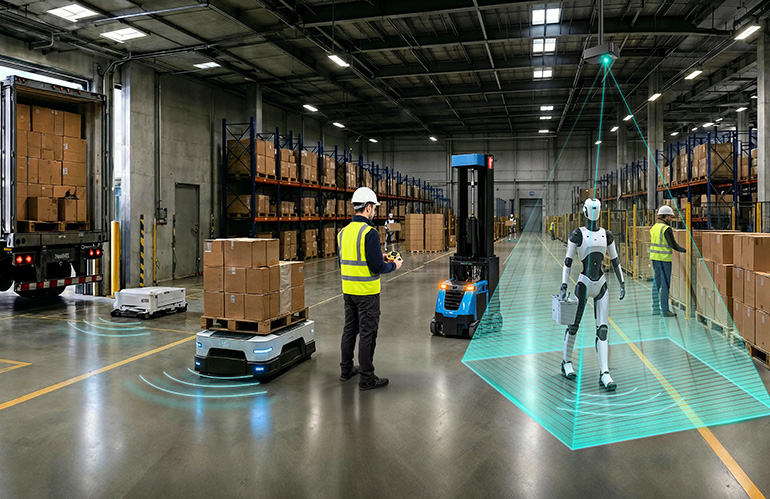
FORT Robotics said it expects valuation of more than $500 million as it lists on Nasdaq with plans to accelerate safety software development. The post FORT Robotics to take safety stack public via SPAC merger appeared first on The Robot Report .
Apple is making changes to its business terms for apps in the European Union, following close collaboration with the European Commission. The changes reduce complexity by moving every developer that distributes apps in the EU to a single set of business terms. Under the new business terms, Apple will charge a commission on the sale of digital goods and services. The Core Technology Fee, a per-install fee for developers who achieve extraordinary scale, will be replaced by the Core Technology Commission, a simple 5% commission on digital transactions in apps distributed outside the App Store. The new terms also eliminate the Initial Acquisition Fee and Store Services Fee. Members of the Apple Developer Program can review and agree to the updated terms today in the Apple Developer Program License Agreement. Some key updates, which go into effect October 1, 2026, include: Adjusting commission rates across the App Store, alternative payments, and alternatively distributed apps. Allowing apps to offer alternative payment options alongside Apple In-App Purchase. Adding child safety protections for alternative payments on the App Store. Expanding the qualifications for developers to operate alternative app marketplaces and distribute their apps over the web. Learn more about the changes You can also request a 30-minute online appointment to ask questions about these changes.
Attachment 14 of the Apple Developer Program License Agreement has been added to specify updated terms for apps in the European Union, including alternative distribution, alternative payments, and business terms. These terms will go into effect on October 1, 2026. Please review the changes and sign in to your account to accept the updated terms. Translations of the updated agreement will be available on the Apple Developer website within one month.
One advertisement featured a pornographic video with a deepfake closely resembling a prominent US politician. Apple removed the app from the App Store after an inquiry from WIRED.