TechnologyNews
Announcing the Agentic Resource Discovery specification
An open specification for finding and verifying tools, skills, and agents across the web.Agents are ...
Google Developers1 min read
Explore
The most-read articles on Virexa, ranked by real reader engagement.
1,000 results • Page 2 of 84
An open specification for finding and verifying tools, skills, and agents across the web.Agents are ...
375 points 263 comments on Hacker News · github.com
Microsoft AI released two new in-house models into public preview on Wednesday — MAI-Image-2.5-Pro , its highest-fidelity image generator to date, and MAI-Voice-2-Flash , a speech model built for high-volume enterprise workloads — while publishing production data that amounts to the company's most aggressive argument yet that it can power its own products without leaning on OpenAI's frontier models. The announcement, made by Microsoft AI's Superintelligence team , lands roughly a year after the company committed to building purpose-built models internally, and it arrives with an unusual level of specificity about where those models now run: Bing , PowerPoint , OneDrive , Dynamics 365 , Excel , GitHub Copilot , and Azure . The message to enterprise buyers — and, implicitly, to OpenAI — is that Microsoft's homegrown models are no longer research projects. They are production infrastructure serving millions of users. "Each of these enhancements is a step toward the same goal: Microsoft products, powered by Microsoft models," the company wrote in its announcement blog. How MAI-Image-2.5-Pro and MAI-Voice-2-Flash stake out opposite ends of the AI cost curve The two new releases occupy opposite ends of what Microsoft calls the quality-speed-cost curve, and the positioning is deliberate. MAI-Image-2.5-Pro targets the premium tier: hero imagery, detailed editing, and precise in-image text rendering — the last of which has long been a notorious weak spot for image generation models. Microsoft priced the model at $5 per million text input tokens, $8 per million image input tokens, and $106 per million image output tokens. The base MAI-Image-2.5 model recently launched at No. 2 for image editing on Arena , the community leaderboard that has become a de facto scoreboard for generative media. The creative industry appears to be taking notice. Rob Reilly, global chief creative officer at advertising giant WPP, called the Pro model "a strong leap forward for GenMedia tools" in a statement included in Microsoft's announcement, adding that "Microsoft has firmly established itself among the leaders in generative AI." MAI-Voice-2-Flash goes the other direction. First previewed at Microsoft's Build conference , Flash runs twice as fast as MAI-Voice-2 and costs 32% less, priced at $15 per million characters. It is designed for the unglamorous but enormous market of high-volume voice — call centers, voice agents, and real-time speech applications where latency and cost-per-call matter more than marginal gains in expressiveness. Together, the two models reflect a strategy of building families of models rather than a single flagship, because, as the company put it, a creative studio chasing maximum fidelity has very different needs from a customer service operation handling millions of calls a day. Microsoft's production metrics show in-house models cutting GPU costs by up to 89% The model launches are arguably less newsworthy than the deployment metrics Microsoft attached to them — numbers that read like a systematic case for swapping out third-party frontier models across its product portfolio. Bing Image Creator now runs entirely on MAI-Image-2.5 , end to end, marking the first time the consumer image tool is fully in-house. In PowerPoint, Microsoft says MAI-Image-2.5 reduces GPU costs by up to 84% compared with GPT-Image-2, OpenAI's image model. In OneDrive, where MAI-Image-2.5 is now the default for key image-editing scenarios, the company reports a 26% increase in save rates, roughly 25% lower P95 latency, and 2.5 times greater efficiency under medium-utilization production workloads. On the voice side, MAI-Voice-2-Flash now powers Dynamics 365 Contact Center — the platform used by customers including T-Mobile and EasyJet — where Microsoft claims GPU cost reductions of up to 89%. The model is also integrated into Azure Voice Live for developers building speech-to-speech agents. Perhaps the most consequential deployment sits in healthcare. Microsoft's Dragon Copilot , used by 170,000 medical providers and responsible for processing 28 million patient encounters last quarter, now runs on MAI-Transcribe-1.5 for its multilingual workflow across 58 languages. Microsoft says internal evaluations show a 50% relative reduction in both transcription and language-identification error rates across most languages — a meaningful claim in a domain where transcription errors can propagate directly into clinical notes. Inside the 'hill-climbing' strategy that lets small models beat GPT-5.6 in Excel In a companion post published the same day, Microsoft detailed the methodology behind these results — what it calls its " hill-climbing machine ," an integrated flywheel of data, models, and the product "harness" that surrounds them. The clearest example is MAI-Code-1-Flash , the lightweight coding model launched in GitHub Copilot in June. Microsoft says the model achieves an approximately 10% higher code accept rate than GPT-5.4 Mini and Claude Haiku 4.5 in VS Code, while using 10% fewer median tokens. Developer retention tells a similar story: users were 6% more likely to return across multiple days than with GPT-5.4 Mini, and 11% more likely than with Claude Haiku 4.5. Then Microsoft did something more interesting. It took the MAI-Code-1-Flash checkpoint and further trained it inside an Excel reinforcement learning environment , teaching a coding model the tools and workflows of spreadsheet knowledge work. The result, according to production user feedback, is a model on par with GPT-5.6 for the most common Excel tasks — while being small enough to run on Nvidia's older H100 and even A100 GPUs rather than requiring the latest-generation accelerators. That hardware detail deserves emphasis. Every major AI company is fighting for allocation of cutting-edge chips, and a model that delivers frontier-adjacent quality on two-generation-old silicon fundamentally changes the deployment economics. It also frees the newest hardware — including Microsoft's now-operational GB200 cluster — for training rather than serving. Satya Nadella's 'frontier diffusion' manifesto redraws the OpenAI relationship Microsoft CEO Satya Nadella framed the announcements in a lengthy post on X titled " Frontier Diffusion & Control ," which functions as something close to a strategic manifesto. "We can now take saturated frontier capabilities and deliver them at scale and at lower cost through models optimized for high-usage products, while continuing to use frontier models for frontier needs," Nadella wrote, adding that Microsoft is "beginning to route traffic across our first-party surfaces to MAI whenever our models match or outperform frontier alternatives." Translated from executive prose: capabilities that were state-of-the-art a year ago are now table stakes, and Microsoft believes it can replicate them cheaply for the specific, repetitive tasks that dominate real product usage. Why pay frontier prices for a frontier model when a user just wants to reformat a spreadsheet column? Nadella was careful to note that "frontier models from OpenAI and Anthropic are part of the orchestration system alongside MAI" — but he also articulated a pointed principle of model independence, arguing that a company's evaluations "should continue to hill climb even when any given model has been removed." “Keeping the harness, memory, context, and skills outside the model, he argued, is what gives Microsoft control. The subtext is hard to miss. Reuters reported in April that Microsoft’s exclusive license to OpenAI’s technology had been revised into a non-exclusive arrangement, and The Information reported last September that Microsoft had begun incorporating Anthropic models into some products. Wednesday’s announcement completes the triangle: Microsoft as orchestrator, with its partners’ frontier models as interchangeable components and its own models absorbing an ever-larger share of routine traffic.” Developers cheer cheaper task-specific models while skeptics question Microsoft's track record The response online captured both the appeal and the skepticism surrounding the strategy. "I love when people use small models for niche tasks," wrote one X user, @mavihsk , responding to Nadella's post. "Why do I have to use the all-knowing model just to change my field in Excel?" Another user, @nabu_lines , distilled the pitch neatly: "cost and performance both improve when you stop overusing the biggest model." Others were less charitable about Microsoft's execution track record. "Microsoft is the worst when it comes to listening to user feedback," wrote designer @designedbyabin , arguing the company "will lose the AI race because they repeatedly failed to understand user needs." And one user, @tokenoverflow , offered a drier critique of the model-independence pitch: "i want it keep hill climbing after removing microsoft." The skeptics raise a fair point. Microsoft's self-reported metrics — accept rates, save rates, GPU savings — come from its own internal evaluations, not independent benchmarks, and the company chooses which comparisons to publish. But the strategy's logic does not depend on any single number. Nadella's framing that software now has " real marginal cost for the first time " explains why Microsoft is obsessive about tokens, GPUs, and serving costs: when AI features run on every keystroke across a billion-user product portfolio, an 84% GPU cost reduction is not an optimization. It is the difference between a viable business and a money pit. Why Microsoft is turning its internal AI playbook into an Azure product The final piece of the strategy is that Microsoft is selling the playbook, not just the models. Nadella explicitly positioned the hill-climbing approach as "a template for every other AI native, SaaS, or Enterprise company," and Microsoft is packaging the toolchain through Foundry and what it calls Frontier Tuning — letting enterprises train specialized models against their own proprietary evaluations and reinforcement learning environments. That turns Microsoft's internal cost-cutting exercise into an Azure product, and it gives enterprise customers a reason to run their AI workloads on Microsoft's cloud even if the models themselves come from elsewhere. The company's emphasis on models trained "on clean, traceable, enterprise-grade data, without distillation from third-party models" serves the same commercial end. In an industry facing mounting scrutiny over training data provenance, Microsoft is betting that enterprise buyers — and courts — will care where model capabilities come from. Microsoft says it is now extending the hill-climbing approach to Copilot Chat , Outlook , and PowerPoint , and both new models are available in public preview through Microsoft Foundry and the MAI Playground . "None of this is an endpoint," the company wrote. "We're just getting started." Seven years ago, Microsoft bet more than $13 billion that OpenAI would build the future of AI. Wednesday's announcement suggests the company has since learned a cheaper lesson: the future of AI may belong to whoever builds the frontier, but the profits belong to whoever makes it ordinary.
Distributed AI training is notoriously fragile because losing a single machine typically crashes the entire multi-node job, forcing a time-consuming, full-workload infrastructure restart. To address this, Google’s JAX ecosystem utilizes elastic training via Pathways, which converts a hardware failure into a catchable Python exception so the running process can survive. When an unplanned failure occurs, the system automatically replaces only the broken worker, restores the last viable checkpoint from Cloud Storage, and resumes training in place—minimizing total downtime to under two minutes without ever restarting the main controller process.
We're excited to introduce LiteRT.js, the newest member of the LiteRT family! LiteRT.js is our powerful solution for running machine learning models directly in the browser, extending Google's cross-platform edge AI runtime to the web. Built for JavaScript developers, LiteRT.js delivers state-of-the-art ML model inference performance on WebGPU and upcoming WebNN, with a fallback to WebAssembly for CPU. This post provides a quick tour of LiteRT.js and gives web developers everything they need to get started.
On May 23, 2026, fresh off the stage at Google I/O, our Google Developer Experts (GDEs) converged on...
2 points 0 comments on Hacker News · aws.amazon.com
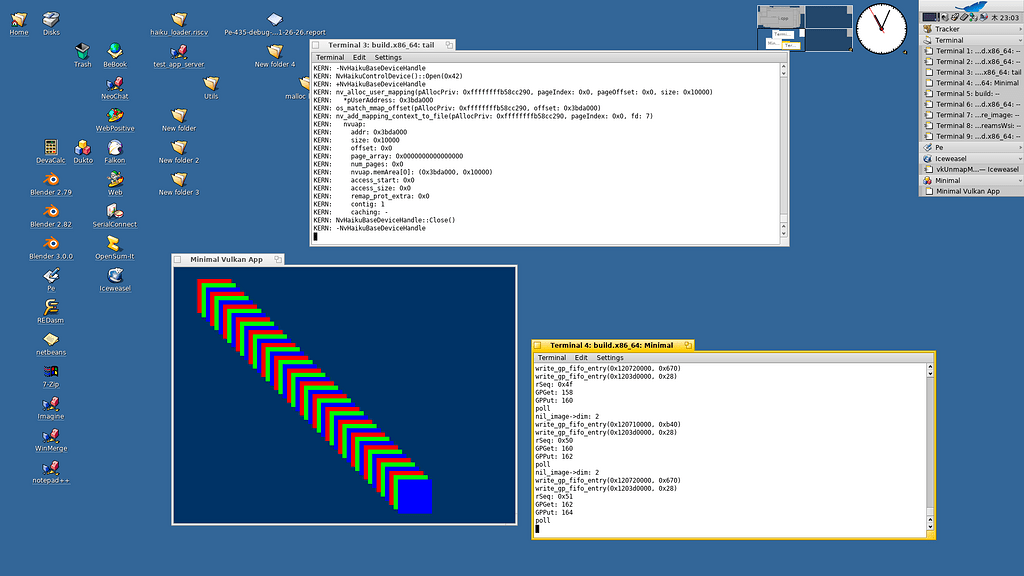
329 points 69 comments on Hacker News · discuss.haiku-os.org
391 points 116 comments on Hacker News · github.com
Google has officially launched the TPU Developer Hub, a centralized educational resource designed to help model builders and developers maximize the performance of Google Cloud TPUs. The hub offers code-first resources, open-source recipes, and deep-dive documentation covering hardware architecture, software optimization, debugging, parallelism, and networking. These materials are tailored for both human developers and AI-assisted tools to streamline everything from large-scale training to low-latency inference workloads.
DiffusionGemma is an experimental text-generation model built on the Gemma 4 architecture that uses diffusion-based parallel generation instead of token-by-token autoregression, enabling much faster inference, bidirectional context awareness, and real-time self-correction while remaining deployable on consumer GPUs. Its architecture generates and refines 256-token blocks in parallel through iterative denoising, allowing it to handle complex constraint-based tasks such as Sudoku more effectively than traditional language models and demonstrating strong gains from fine-tuning. The model integrates with vLLM and other popular inference frameworks, giving developers access to a new non-autoregressive approach that combines high performance, efficient long-context scaling, and straightforward customization and deployment.
Farmers have a crucial role in cleaning up one of the UK's most polluted river systems, a study shows.
Hacker News
“GPT-5.5's API pricing is reshaping how startups build AI products”