Adding an AI agent to Slack sounds appealing to many enterprises — but, as VentureBeat has experienced ourselves first hand — the reality is often far more complex and clunkier than it first seems. Now NanoCo ., the company behind the hit open source, enterprise-friendly, autonomous AI agent harness NanoClaw (a more sandboxed, lower code version of OpenClaw), is hoping to make it just as easy as typing a Slack message. To go one step further: the company's new NanoClaw Slack integration lets human users spin up entire teams of agents with their own specialized skills, workflows, and even custom avatars, all from a single Slack prompt. "In the next 12 to 18 months, everyone on a team will be a manager of agents," NanoCo CEO and co-founder Gavriel Cohen told VentureBeat in an exclusive interview. Furthermore, the NanoClaw agents can work together in channels and shared Slack Canvases, and can even be messaged outside of Slack on other platforms like Telegram or WhatsApp, letting their human colleagues ping them across messaging platforms, just as they would their fellow humans. “I think this is agents arriving natively in Slack for the first time,” Cohen added. “In the past, you had to do all these weird things to try to have multiple different agents behind the scenes using the same bot, and now every agent gets its own identity in Slack — its own avatar, its own face, its own name. You can tag them. They can tag each other.” For enterprise teams, the more consequential part is persistence and separation. NanoClaw is not presenting the additional workers as invisible subagents that disappear after one task. Each can be given its own role, memory context, instructions and permissions, creating a structure closer to a small digital department than a single chatbot with a long prompt. As with the original open source version of NanoClaw released in January 2026 , developers and enterprises can further choose whichever underlying large language model (LLM) they wish to power their NanoClaw agents, optimizing for performance, cost, or other combinations of factors. From a single NanoClaw Slack agent to a whole specialized team For a new installation, NanoClaw’s current setup process starts by cloning the project and running its nanoclaw.sh installer, which walks the user through dependencies, credentials, building the agent container and pairing a first messaging channel. NanoClaw’s website says the installer takes a user “from a fresh machine to a named agent you can message,” with Slack among the supported channels. Cohen described the Slack-specific flow to
VentureBeat
as a significant simplification over building a traditional Slack bot. Previously, he said, a user would have to navigate Slack’s administrative and developer interfaces, create an app, collect secrets, API keys and tokens, and then move those credentials into wherever the bot was running. With the new integration, the NanoClaw setup instead offers a Connect Slack option. The user names the agent, authenticates, chooses the NanoClaw Add to Slack option and goes through Slack’s installation and authorization flow. Once authorized, the first agent can appear in Slack and begin communicating with the user. The important distinction is that this initial authorization is largely a one-time workspace connection. Slack’s Marketplace listing says users “connect a workspace once,” after which NanoClaw can provision each additional agent as its own Slack bot, complete with its own name, generated avatar and identity. Those agents continue running on the customer’s infrastructure and connect to Slack over Socket Mode. NanoCo says it does not store the agents’ Slack tokens; according to the Marketplace listing, those tokens remain on the user’s machine. Slack’s standard administrative controls still sit around that system. Organizations can apply their normal app-approval policies to the NanoClaw integration, while NanoClaw’s Marketplace listing says the app’s Home tab displays the agents provisioned in a workspace and lets users revoke individual agents or disconnect the workspace entirely. The result is less a one-click replacement for NanoClaw’s underlying infrastructure than a one-time bridge between that infrastructure and Slack: users still own and operate the agent runtime, but once the bridge is authorized, the agents themselves can create and coordinate additional Slack-native colleagues without sending the user back through manual app configuration each time. Behind the scenes, Cohen said, the lead agent has a Model Context Protocol (MCP) tool that can create new agents and define their instructions, personas, skills and tools; another tool can place them into shared rooms. The agents come prepared to work with Slack Canvas and can communicate with every human user on the Slack Channel, and with one another. The interaction itself is deliberately simple. Rather than opening a separate agent builder every time a new role is needed, Cohen said users can tell the agent they already have what kind of colleague or team they want. “Your agent in Slack, you can say, ‘Create me another agent to handle my code reviews. Create another agent to review the contributor articles. Create a team of agents that reviews contributor articles from different perspectives.’ And then your agent can create new agents, and they just pop up in the sidebar and send you messages.” That means a developer could ask for a product manager, architect, implementation agent, code reviewer and testing agent, then give each a different toolset and have them hand work between one another. Cohen said the testing agent, for example, could have access to a testing environment while the review agent carries code-review-specific skills and the product agent monitors user feedback. Cohen argues that this division of labor is more than cosmetic role-playing. “There are advantages in terms of giving each one specific skills, instructions, and tools for different tasks,” he said. “I can have, let’s say, a code review agent, a code testing agent, a code writing agent, and I can have them in a loop.” If the implementation agent runs into an ambiguity, he added, it can tag the product or architecture agent for clarification rather than forcing one general-purpose model to hold every responsibility and tool in the same context. Agents work together with humans on a share Slack Canvas A supplied demo screenshot shows the same pattern applied to marketing: a lead agent named Nano creates Atlas for strategy, Sage for content, Echo for social, Scout for outreach and Compass for SEO and analytics. The agents introduce themselves in the same Slack conversation and begin coordinating work, with Atlas noting that it had added an item to Canvas so the task would not get lost. Users do not have to specify every detail up front. Cohen said someone could give the lead agent exact review procedures, priorities and required tools, or leave more of the configuration to the agent based on its existing context and memory. The design also tries to avoid a familiar multi-agent failure mode: bots endlessly triggering one another. NanoCo says the agents reply only when tagged, while comments left on work in Canvas can be routed back to the agent responsible for that piece. And the model can extend beyond teams of task-specific bots created by one person. Cohen described a workplace where individual employees each have persistent agents that can communicate with one another under human-defined policies. “Each person having their own agent means that I could have my agent and you have your agent in Slack, and your agent can ask my agent questions,” he said. “Maybe I’m out of the office for the day. Your agent can ping my agent and ask a question about availability, and I can set some policies about whether my agent can answer or if I need to give approval.” That pushes the concept closer to organizational delegation: some agents specialize by function, while others effectively represent individual employees and the context they have accumulated. Cohen said the agents can be equipped with browser and internet access, memory, coding capabilities and other tools, while newly created agents arrive with built-in support for Canvas work, agent-to-agent communication and spawning still more agents. Slack is opening the door to more third-party agents The underlying Slack change is broader than NanoClaw. In April, Slack, a Salesforce product, announced the ability to add external AI agents to the messaging platform directly, initially pointing to Vercel and Lovable and saying those integrations were coming in late May. Slack said the deployment mechanism automates OAuth, manifest configuration and environment setup so an externally built agent can be brought into the workspace without being rebuilt specifically for Slack. Salesforce’s newly published Slack Code page now names NanoClaw alongside Lovable, Hyperagent, Superhuman, n8n, Vercel, ChatGPT, LangChain, Runlayer and Skydive, and says Add to Slack can bring agents from those platforms into Slack in a few clicks with their own identity. Slack is already crowded with AI assistants. OpenAI, for example, lets ChatGPT workspace agents be deployed into Slack channels, where they can answer questions, perform tasks through connected systems and output files. Slack also supports Claude and custom Agentforce agents. NanoClaw’s differentiation is therefore not simply “AI in Slack.” It is the ability for an already-running agent to create additional, independently addressable teammates from inside the conversation itself. NanoCo calls that a first for Slack; that specific market-first claim is the company’s. “Add to Slack means one message can spin up a full team of NanoClaw agents, working right alongside people in Slack,” Josh Milas, director of product management at Slack, said in the supplied announcement. How NanoClaw differs from Claude Tag, ChatGPT agents and Agentforce in Slack NanoClaw is not alone in trying to turn AI from a sidebar chatbot into something resembling a persistent Slack colleague. Anthropic’s Claude Tag , which began rolling out in beta to Claude Team and Enterprise customers in June, may be the closest conceptual comparison. Administrators can give @Claude access to selected channels, tools, data sources and codebases; everyone in the channel can then delegate work to it by tagging it. Claude remembers relevant information from the channels it inhabits, can work asynchronously over hours or days, and, when administrators enable its “ambient” behavior, can proactively flag information or revive unresolved work without waiting for another prompt. Anthropic says separate Claude identities can also be scoped to different use cases so that, for example, a sales Claude does not share its memories or tools with an engineering Claude. The difference is in how those digital coworkers are provisioned and organized . Claude Tag’s documented workflow is administrator-led: admins pair Claude with Slack, decide which channels, tools and information each Claude identity can access, set spending limits and then expose those identities to employees. Within a given channel, Anthropic describes “one Claude that interacts with everyone.” Its public documentation does not describe an end user asking that Claude to create several new, independently named Slack bots on demand. NanoClaw’s model is almost inverted. After an organization connects its NanoClaw installation to Slack once, NanoClaw says an existing agent can itself provision additional agents from a conversational request, with each new worker receiving its own Slack bot identity, name, generated avatar and token and running back on the customer’s infrastructure. OpenAI’s ChatGPT Workspace Agents occupy another point on that spectrum. Business, Edu and Enterprise customers can build reusable agents in ChatGPT, give them instructions, models, files, apps, custom MCP connections and schedules, and then attach those agents to Slack channels. Builders assign each agent a unique Slack handle and can configure it either to respond only when mentioned or to respond automatically to relevant messages in a channel. But the construction still happens primarily through ChatGPT’s agent builder: OpenAI’s setup documentation tells users to create the agent first and then add Slack as a channel. Under the hood, the Slack handles rely on Slack user groups managed by the ChatGPT Agents app, rather than NanoClaw’s model in which every provisioned agent is itself a separate Slack bot. Salesforce’s Agentforce similarly allows organizations to create multiple specialized agents that employees can DM or @mention inside Slack, and it arguably provides the most conventional enterprise administration model of the group. Companies build the agents in Agentforce Builder, often starting from Slack-specific templates for jobs such as customer insights, employee help or onboarding, and can add subagents and actions that let them search information, create Canvases or perform other work. Once configured and activated in Salesforce, administrators bring those agents into Slack for employees to use. That makes Agentforce powerful for organizations already centering identity, data and workflows on Salesforce, but again places agent creation before deployment rather than making creation itself something an existing Slack agent can perform during a conversation. That distinction helps clarify what NanoClaw is actually adding to an increasingly crowded market. Slack itself now provides an Agent Kit for developers and a deployment standard for agents built on outside platforms, automating pieces such as OAuth, manifests and environment configuration. Claude Tag, ChatGPT Workspace Agents and Agentforce all demonstrate that persistent, specialized AI teammates inside Slack are no longer novel on their own. NanoClaw’s more unusual bet is recursive provisioning: Slack becomes not merely the place where workers invoke agents, but a place where an existing agent can assemble additional named agents, assign them roles and put them together in a channel as a working team. There are tradeoffs to the different approaches. Claude Tag comes with Anthropic-managed models and centralized administrative controls, including channel-specific permissions, audit logs and token-spending limits, while also offering proactive “ambient” behavior that NanoClaw’s supplied materials do not claim in the same way. ChatGPT Workspace Agents offer a managed agent builder, schedules, app connections and organization-level publishing and access controls. Agentforce ties agents closely to Salesforce permissions, enterprise data and predefined business actions. NanoClaw instead emphasizes self-hosting, open-source modification and separate agent identities , shifting more control — and more operational responsibility — to the organization running it. The result is less a direct replacement for those systems than a different answer to the same emerging question: whether enterprises want a small number of centrally configured AI assistants, or an environment in which employees and existing agents can continuously create specialized digital colleagues as new work appears. How NanoClaw got here NanoClaw began far from the enterprise collaboration market. Cohen, a former Wix engineer, launched it under the MIT License on Jan. 31, 2026, as a deliberately small, security-focused alternative to OpenClaw. The original pitch was that a personal agent with access to messages, files and tools should run inside an OS-isolated container rather than directly on the host, and that the orchestration layer should remain small enough for a developer or security team to understand — an initial core of roughly 500 lines of TypeScript and a design centered on container isolation and a minimal single-process architecture. The project then moved steadily toward enterprise infrastructure. In March, NanoClaw partnered with Docker to run agents inside Docker Sandboxes, using stronger MicroVM-backed isolation for workloads that may install packages, modify files and launch processes. In April, NanoClaw 2.0 added Vercel’s Chat SDK and OneCLI’s credential gateway, allowing organizations to define policies around sensitive actions and require human approval before credentials are injected for protected requests. By May, Cohen and his brother Lazer Cohen had formed NanoCo around the project and raised a $12 million seed round led by Valley Capital Partners, with Docker, Vercel, monday.com and others participating. The commercial strategy is to keep NanoClaw open source while selling managed, organization-wide deployments and “professional assistant” infrastructure to enterprises. The company now says NanoClaw has surpassed 250,000 downloads and 30,000 GitHub stars. That open-source structure remains central to Cohen’s pitch as NanoClaw moves deeper into workplace infrastructure. “You’re really able to now integrate an open-source agent into Slack that you fully control,” he said. “You can change all those configurations. Plus, you can fork NanoClaw and completely rewrite or change behaviors — create your own memory system, your own coding harness, agent harness. Whatever you want to do, you can do. Total freedom.” Persistent agents, but infrastructure stays under the user’s control Cohen said NanoClaw remains self-hosted: an organization can run it on a local machine or its own cloud VM, with agent data stored there. The same agent can also appear across Slack, WhatsApp or Telegram while retaining the same memory, workspace and tools, although each messaging surface uses a separate session. NanoClaw can pull recent context across those sessions so the agent can maintain continuity without merging every chat history into one stream. NanoClaw’s documentation likewise describes a multi-channel architecture in which the same agent can retain one workspace and memory while maintaining separate per-channel sessions. “This is all self-hosted,” Cohen said. “You’d be running this on your computer or on your virtual machine in the cloud, and that data is stored on your computer or on your [virtual machine] VM. This could be an open-source model running on your Mac Mini, and your data isn’t going anywhere besides your Mac Mini and then into Slack.” The cross-channel continuity is also intended to make an agent feel less like a Slack-specific bot and more like a persistent colleague that happens to be reachable through Slack. Cohen said the same agent could exist in Telegram, WhatsApp and Slack with access to the same memory, files and tools. The conversations remain separate sessions, but they share a workspace and persistent context so the agent can carry knowledge from one surface to another. That architecture matters when an organization starts creating many agents. Cohen said one agent can see its own sessions across channels, but not another agent’s private sessions by default. NanoClaw’s current documentation likewise describes agents running in their own sandboxes and configurable model providers, with Claude Code as the default and Codex, OpenCode and local Ollama models available as alternatives. There is one cloud dependency for the new Slack flow. Cohen said NanoCo operates a small service that handles Slack provisioning requests and avatar generation. He said it does not receive users’ messages or agent memory. Continued commitment to open source NanoCo is not charging for this community Slack capability, according to Cohen, and is absorbing the provisioning-service and avatar-generation costs. Users can still incur their own model inference and hosting expenses, so that does not make a deployed agent team cost-free in practice. NanoCo says the integration is available through the Slack Marketplace, subject to normal workspace app approval and governance. Slack says workspace owners and administrators can require apps to be approved before installation. Cohen framed that decision as part of NanoCo’s broader open-source strategy rather than a standalone monetization play. “We’re not making any money off this one. This one is for the community, really,” he said. “We know that in the long run that’s going to benefit NanoCo as a company. As NanoCo grows and builds out capabilities, those go back to the open source. I think that’s the new model of open source, where we’re not trying to monetize every bit of value we bring to the community.” Whether companies get there that quickly will depend less on how easily agents can be created than on whether IT teams can govern their permissions, memory, spending and failure modes at the same pace. NanoClaw is betting that the next problem is managing the digital coworkers that appear once that barrier is gone.
Serval is making Catalyst , its AI agent for building enterprise automations, generally available Thursday and enabling it by default for customers — allowing teams of AI agents to decide what should be automated and then build the automation itself. Catalyst sits above Serval’s AI-native service management platform as an admin-facing “super agent.” It can inspect ticket history, standard operating procedures or natural-language instructions, identify recurring work, and draft the workflows, skills, forms, access policies, journeys and dashboards needed to automate it. Serval is also using Catalyst to create background agents that continuously inspect connected systems for emerging problems and propose fixes before an employee files a ticket. That distinction matters because enterprise service management vendors are rapidly converging on AI-assisted workflow creation. ServiceNow’s Build Agent can already translate natural-language instructions into full-stack applications, flows, scripts and other platform metadata, while its AI Agent Advisor can analyze instance records to identify automation opportunities. Atlassian’s Rovo can generate Jira automation flows from plain-English requirements, and Freshworks offers Freddy AI Agent Studio for creating service agents that act across Freshservice workflows. So Serval’s claim to differentiation is narrower — and potentially more consequential — than simply “we use AI to build workflows.” Catalyst is designed as a single administrative layer that can move from discovering an opportunity, to assembling multiple kinds of governed automation, to creating proactive agents that keep looking for new work to automate. "You just started with a single prompt, and now you’ve got enterprise-grade workflows ready to deploy that are going to solve all password resets for the entire company," Serval co-founder and CEO Jake Stauch told VentureBeat in an interview. From ticket history to working automation Serval says Catalyst analyzes existing help desk data before an organization has decided what to automate. If it finds a repetitive category of requests, it can draft the automation required to resolve those requests and stage the result for administrator review. Users can also upload an SOP or spreadsheet and ask Catalyst to turn the documented process into an executable system. Serval’s documentation says Catalyst can build workflows, author help desk skills, create onboarding and offboarding journeys, configure access-management policies, construct dashboards, investigate operational issues and debug failed workflow runs. Unlike Serval’s earlier workflow builder, Catalyst is intended to become the primary interface for configuring the platform; the company says its long-term goal is that anything an administrator can do through the UI should also be possible through Catalyst. The actual workflows are code-backed. In a demonstration, Stauch showed Catalyst taking a request to build password-reset workflows, detecting connected systems including Okta, Google Workspace and Microsoft Entra, and generating the underlying TypeScript needed to perform those actions. Administrators could then add approvals or restrict who was allowed to run the workflow. The models underneath Catalyst are deliberately swappable Serval is not building its own foundation model. Stauch said in the interview that the company uses models from “frontier labs,” runs evaluations to determine which models work best for particular jobs, and is deliberately model-agnostic. “You can swap different models in,” he said, adding that Serval also works with enterprises that build their own models. Stauch provided more detail in a May 2026 interview with Sequoia Capital , saying Serval was using both OpenAI and Anthropic models. He said OpenAI’s GPT models had performed best for end-user interactions and tool calling, while Anthropic’s Sonnet and Opus models were producing the strongest results for the code-generation side of Serval’s automation system — the workload most directly relevant to Catalyst. Serval continuously runs evals rather than automatically moving every workload to the newest model release, Stauch said. That architecture makes the underlying LLM less central to Serval’s differentiation. The company’s own documentation now lets organization administrators supply their own OpenAI or Anthropic API keys, including a compatible custom endpoint, while Stauch said the broader architecture can accommodate different models. The materials do not, however, establish that every Catalyst user gets a self-service menu for arbitrarily choosing an individual model. Serval’s pitch is instead that its proprietary value sits in the harness around those models: enterprise context and memory, integrations, generated code, permissions, approvals and the controls governing what an agent can actually do. That code-generation model is central to Serval’s pitch against ServiceNow. Stauch argues that legacy ITSM deployments often accumulate custom tables, business rules, workflows and platform-specific expertise that make seemingly simple automation changes expensive to implement. Serval, by contrast, wants administrators and business teams to describe the outcome they need and let the model generate the implementation. But ServiceNow is no longer standing still on that front. Its current Build Agent similarly creates applications and code from natural-language prompts, supports flow design and testing, and operates inside ServiceNow’s governance framework. ServiceNow’s AI Agent Studio lets customers create agents and agentic workflows, while AI Agent Advisor is explicitly designed to analyze operational records for automation candidates. The competitive question is therefore shifting from “who has generative AI?” to how many separate tools, configuration concepts and specialists are required to get from an observed operational problem to a production automation. Serval is effectively arguing that Catalyst compresses those steps into one conversational surface and a smaller platform model. ServiceNow, by comparison, now has a powerful but broader set of AI and development surfaces spanning Build Agent, AI Agent Studio, AI Agent Advisor, Workflow Studio and AI Control Tower. That breadth is an advantage for customers already deeply invested in ServiceNow, but it also illustrates the complexity Serval is attacking. ServiceNow itself notes that Build Agent is aimed at admins and developers who understand and can support what it generates. Atlassian is moving in the same direction from a different starting point. Rovo can generate “if this happens, then that happens” automation flows from natural-language descriptions, while Jira Service Management increasingly supports agents that triage, investigate and execute service work. Freshworks ’ Freddy AI Agent Studio likewise emphasizes agents that resolve requests end-to-end, with prebuilt IT and HR agents and more than 30 workflow templates. Catalyst’s differentiator, then, is not that rivals cannot generate an automation from a sentence. It is Serval’s attempt to make the entire automation lifecycle itself agentic. Building agents that look for trouble before a ticket exists That approach becomes clearest with Serval’s background agents. Rather than waiting for a help desk request, a background agent can run on a schedule across connected systems, correlate signals and draft a remediation. In one customer example provided by Serval, an agent correlated network incidents across two offices using switch telemetry, DHCP data and historical tickets, ruled out hardware and wireless interference, traced the issue to configuration drift, and generated a remediation workflow for an administrator to approve. “Most AI agents today wait for an employee to ask a question or submit a ticket,” Stauch said. “We believe the future is AI that acts before an employee ever submits a request.” That framing also highlights a philosophical difference in Serval’s pitch. The startup does not want service management to revolve around creating, routing and tracking better tickets. It wants the system to eliminate as many requests as possible by turning repeated support work into executable automation. "A lot of the code written in enterprises has nothing to do with software engineering," Stauch explained. "It’s actually internal automations and other scripts for the company, and so we use that technology to build a better service management platform." Serval's pitch to enterprises is that it can largely automate those scripts. And the governance model is critical because Catalyst can generate code and potentially initiate changes across production systems. Serval says Catalyst inherits the permissions of the user operating it and remains scoped to that user’s team workspace. Everything it builds starts as a draft, and organizations can restrict publishing privileges or require formal review and approval before an automation becomes active. Customer data remains customer-owned, with several deployment options Those controls also extend to the enterprise data Catalyst examines. Stauch said Serval is intended to operate as the customer’s system of record and told VentureBeat that “they own all the data.” Serval’s current Master Services Agreement is more precise: customers retain rights, title and interest in both their “Customer Materials” — a category that includes records, documents, workflows, prompts, inputs and configurations — and the output Serval generates from them. Serval receives the rights necessary to process that information to provide, maintain, support and secure the service. Serval also says it does not retain or use customer materials, inputs or outputs to train, fine-tune or improve its own or third-party AI models. Its Data Processing Addendum identifies Serval as the processor of customer personal data and allows processing for operating the service, responding to support requests, diagnosing issues and protecting the platform, while authorized subprocessors can also be involved. Serval’s acceptable-use terms say it maintains a current list of AI subprocessors and model providers for customers. Where that data resides can vary by deployment. Stauch said customers can use Serval as a cloud SaaS service, run it on-premises or place it in their own VPC. Serval’s self-hosting documentation now describes two fuller options: a Serval-managed single-tenant deployment inside an AWS account owned by the customer, or a self-managed deployment on the customer’s Kubernetes cluster in any cloud or on-premises environment. In the AWS option, Serval says it operates the installation without persistent IAM access to the customer’s AWS account. There are therefore two distinct access boundaries for enterprise buyers to consider. At the Catalyst level, the agent can only reach data, integrations and automations available to the user and team workspace under which it is operating. At the platform level, Serval and authorized subprocessors necessarily process customer information to deliver and support the service, subject to the company’s contractual confidentiality and data-processing terms. That makes Stauch’s informal statement that Serval “doesn’t touch” customer data better understood as an ownership and deployment claim, rather than a literal assertion that the service never processes it. Ramp and other customers provide an early test Customer deployments provide some evidence that the faster-build thesis can translate into operational changes, although the metrics come from Serval’s own case studies. Corporate expense and financial technology firm Ramp says in a Serval case study that Catalyst has made workflow building 50% faster and helped extend Serval across roughly 10 teams, including IT, finance, facilities, people and talent, legal and business operations. In one hardware replacement program, Serval says Ramp automated 600 laptop replacements and saved 150 hours, leaving approval as the principal human step. The more telling Catalyst example may be what happened afterward. Ramp had already automated laptop replacement when Catalyst suggested splitting its shipping logic into separate office and home workflows to reduce errors. The company also says employees outside IT now use Catalyst for analytics, bulk ticket operations, workflow troubleshooting and HR process automation. Other Serval deployments show the broader operating environment Catalyst is meant to configure. Mercor says it has onboarded more than 4,000 external experts through Serval automations and expanded the platform across seven teams. Together AI says Serval automates 95% of its just-in-time infrastructure access requests, with approval and auditing controls around sensitive access. Perplexity says Serval automatically handles more than half of its incoming IT requests and all employee onboarding. Those deployments extend beyond Catalyst itself, but they demonstrate the type of cross-system automation substrate Catalyst is now being asked to build and maintain. Serval says more than 90% of customers adopted Catalyst as their starting point for automation during beta. Catalyst is generally available Aug. 20 and will be enabled by default for all Serval organizations. Pricing and the battle with ServiceNow Pricing is customized depending on the size of the deployment and is not publicly listed on Serval's website or documentation. Serval describes a single platform fee and typically runs a pilot to determine expected deployment and usage. Stauch said the software license can be similar to ServiceNow’s, but argues total cost of ownership can be substantially lower because customers require fewer implementation and maintenance services. "The total cost of ownership is going to be dramatically less — usually half as much, sometimes 10 to 20% of the total cost of ownership of ServiceNow," Stauch said. "But the actual software license fee is not necessarily going to be all that different." Serval's origin story and history Serval was founded in 2024 by Stauch and CTO Alex McLeod, former Verkada product and engineering leaders, after they repeatedly heard IT customers complain about overburdened help desks and the limitations of established IT service-management software. Serval has positioned itself as an AI-native alternative to platforms such as ServiceNow and Jira Service Management, combining help-desk ticketing, access management, asset management and workflow automation within a single system. Serval and Sequoia Capital describe the company’s goal as moving IT software beyond merely recording and routing requests toward resolving them automatically. The company can operate as an organization’s primary IT service-management system or add automation to an existing one. Its publicly identified customers include Perplexity, Mercor, Clay, Verkada and Together AI. Serval says customers can automatically resolve more than half of their incoming IT requests; its Together AI case study reports automation of 95% of that customer’s just-in-time access requests. Investor interest accelerated rapidly in late 2025. Serval announced a $47 million Series A led by Redpoint Ventures in October, bringing its funding at that point to $52 million. In December, it raised another $75 million in a Sequoia-led Series B at a $1 billion valuation , lifting total capital raised to approximately $127 million; Redpoint, Meritech Capital and General Catalyst also participated. Serval told Reuters that revenue had grown 500% since August 2025 and that it was expanding beyond IT into operational work performed by human resources, finance and legal departments. The big test for enterprise customers For enterprise buyers, Catalyst’s biggest test will be whether its compression of the automation lifecycle survives contact with large, messy, highly customized environments. ServiceNow can now generate applications and discover automation opportunities with AI. Atlassian and Freshworks are adding increasingly capable agentic automation to their own service platforms. Serval therefore cannot rely on natural-language creation alone as its moat. Its stronger wager is that an AI-native platform can make the administrative layer itself agentic: continuously finding repetitive work, building the necessary resources across the service stack, exposing generated code for review, and proposing the next automation before an administrator has opened a workflow designer. If Catalyst works at that scope, the competitive unit is no longer the ticket — or even the workflow. It is the system that keeps turning an enterprise’s operational history into new automation.
Another day, another new AI agent harness is released. Only this time, it's one that aims to solve a growing enterprise problem as AI agents proliferate: enabling greater developer control of agents and tools, while reducing cost. TrueFoundry , a San Francisco B2B machine learning startup co-founded in 2021 by former Meta engineers, has released its own custom TrueForge harness under the permissive MIT License on Github . Thus, it can be used with any of a developer (or their parent enterprise's) preferred AI models, forked, modified, self-hosted and incorporated into commercial products. The company states in a blog post that when it used TrueForge paired with the open source GLM-5.2 LLM to successfully complete 11 of 14 tasks on DevRev’s Enterprise-Bench — testing multi-step tool use across CRM, issue tracking, and document management systems — it cost 75% less than achieving the same results with Anthropic's Claude Managed Agents harness powered by Claude Opus 4.8 ($2.90 compared to $11.80). Using the same model in each harness, Opus 4.8, TrueFoundry still claims a cost savings of roughly 30% using TrueForge compared to Claude Managed Agents ($8.50 vs $11.80). Why is TrueFoundry giving this powerfully efficient harness away for free? "We’ve had this ask from a bunch of customers," said Anuraag Gutgutia, TrueFoundry’s co-founder and COO, in an exclusive interview with VentureBeat. "You have an ability where you bring in agents and MCPs — can we also get something where you can actually launch these managed agents? I think that is the need we are satisfying. It is not a replacement. People will use this alongside other harnesses, like the cloud-managed ones or the commercial-provider-managed ones, but this will serve as a way for people to use them in a vendor-neutral way and also at a lower cost.” Indeed, TrueFoundry already offers a paid " AI Gateway " for enterprises centrally controlling model and MCP access, credentials, permissions, budgets and observability. TrueForge, by contrast, handles what happens above that gateway: the loop that lets a model repeatedly reason, call tools, receive results and continue working until a task is complete. For enterprise developers, the practical proposition is that they can start locally with a single command and SQLite, then move the same agent harness into a shared deployment using Docker Compose or Helm with Postgres and Redis. TrueFoundry explicitly warns that the local configuration is intended only for use on a developer’s machine, not as an internet-facing production service. Gutgutia said the company ultimately wants its AI Gateway to become the common layer beneath whichever agents and harnesses an enterprise chooses. “There will be a set of companies that will use our harness as the way to launch managed agents,” he said, while others may continue using Claude, other open-source harnesses or internal systems. “But all that traffic should still be flowing through our gateway.” Context management is where TrueForge tries to cut waste TrueForge’s architecture centers on context engineering — controlling how much information gets sent back into the model on every step of an agent run. That includes delaying the loading of MCP tool schemas until they are needed, delegating isolated tasks to subagents, moving oversized tool results into files instead of stuffing them into the active context window, processing structured results through code, and automatically compacting long-running conversations. The documentation sets the default compaction threshold at 50,000 tokens, though it can be changed per agent. TrueForge also treats the sandbox differently from runtimes that keep an agent inside an isolated environment throughout its run. The core agent loop remains on the TrueForge server; a sandbox is provisioned as a tool only when the agent needs to execute code or work with files. TrueFoundry says that reduces unnecessary compute and allows a server to run more agents concurrently. The company argues those choices directly reduce model spending. How TrueForge compares to Claude Managed Agents and other leading orchestration harnesses Type / focus TrueFoundry TrueForge: General-purpose production agent harness designed for enterprise deployments. DeepSeek Harness: Open-source agent harness, currently positioned as a developer preview. OpenAI Codex CLI: Coding-focused agent harness designed primarily for software-engineering workflows. LangChain Deep Agents: General-purpose agent harness built on LangGraph. Anthropic Claude Managed Agents: Fully managed production agent runtime operated by Anthropic. License TrueFoundry TrueForge: MIT. DeepSeek Harness: MIT. OpenAI Codex CLI: Apache 2.0. LangChain Deep Agents: MIT. Anthropic Claude Managed Agents: Proprietary. Price TrueFoundry TrueForge: The open-source harness itself is free. Model, sandbox and infrastructure costs are separate. TrueFoundry also offers an optional commercial governance layer through its broader platform. DeepSeek Harness: No harness license fee. Users separately pay for whatever model providers and infrastructure they use. OpenAI Codex CLI: The CLI is open source. Underlying model/API or subscription costs are separate, OpenAI says around $100–$200 per developer per month, although actual spending varies substantially with model choice LangChain Deep Agents: Open source, with model and infrastructure expenses separate. LangChain also offers optional commercial services through LangSmith. Anthropic Claude Managed Agents: Claude tokens consumed plus $0.08 per running session-hour, with runtime metered to the millisecond. Model flexibility TrueFoundry TrueForge: Vendor-neutral and designed around bring-your-own-model support. DeepSeek Harness: Multi-provider and not restricted to DeepSeek models. OpenAI Codex CLI: Supports configurable inference endpoints, including OpenAI-compatible services and local-model options. LangChain Deep Agents: Broad multi-provider support through the LangChain ecosystem. Anthropic Claude Managed Agents: Claude-centric. Deployment TrueFoundry TrueForge: Can run locally as a single process with SQLite, then move into a production deployment using Docker Compose or Helm with Postgres and Redis. DeepSeek Harness: Designed for local or self-hosted operation. OpenAI Codex CLI: Primarily a local CLI experience, alongside OpenAI-hosted Codex products and services. LangChain Deep Agents: Can be self-hosted or deployed through LangChain and LangSmith infrastructure. Anthropic Claude Managed Agents: Anthropic manages the runtime and infrastructure. Key features TrueFoundry TrueForge: MCP and tool orchestration, subagents, human approval checkpoints, persistent sessions, context compaction, large-result offloading, Code Mode, generative UI, tracing and a sandbox-as-a-tool architecture. DeepSeek Harness: Pluggable models, tools, session storage and agent loops, along with sandboxing, permissions, approval gates and skills. OpenAI Codex CLI: Agent loop, repository and file operations, shell execution, MCP tools, sandboxing, permissions, approvals and context management. LangChain Deep Agents: Planning, subagents, skills, filesystem-based context management, persistent memory, human-in-the-loop controls, MCP support and multiple sandbox backends. Anthropic Claude Managed Agents: Managed execution environments, persistence, tools, sandboxing and infrastructure for long-running agents. Key differentiator TrueFoundry TrueForge: Its strongest distinction is the combination of an open-source, vendor-neutral harness with a clear path from local development to a shared production runtime, plus an optional enterprise governance plane through TrueFoundry. DeepSeek Harness: Emphasizes deep modularity. Major parts of the runtime, including models, tools, storage and the agent loop, are designed to be replaceable plugins. OpenAI Codex CLI: Stands out as a highly developed software-engineering-specific harness rather than a general-purpose enterprise agent server. LangChain Deep Agents: Benefits from the broader LangChain and LangGraph ecosystem and offers a mature open-source path for building general-purpose agents. Anthropic Claude Managed Agents: Minimizes operational burden by having Anthropic manage the runtime, but trades that convenience for tighter model and platform coupling. Open source does not automatically mean governed For enterprise buyers, one of the most important distinctions is between TrueForge by itself and TrueForge connected to TrueFoundry’s commercial AI Gateway. The open-source harness can run independently. But it does not magically inherit an organization’s enterprise access policies on its own. “If you are using just the open source version of our agent harness, yes, you will need to put the right controls therein or in front of some other internal control system,” Gutgutia told VentureBeat. When paired with TrueFoundry’s gateway, the company says agents can inherit the identities and access controls already attached to models, MCP servers, tools, skills and other agents. Gutgutia described the gateway as the place where enterprise SSO, identity providers and granular permissions can be centrally enforced rather than reimplemented separately for every agent. That distinction is likely to be important for platform engineering teams evaluating the project. TrueForge is free software; TrueFoundry’s governance layer is the commercial control plane around it. TrueFoundry says NetApp was a beta user of the harness and contributed requirements during development. Gutgutia said NetApp’s IT organization has used the technology for incident response and faster ticket triage, while also exposing internal agents as self-service tools for developers. He also identified Automattic as an early user. Background on TrueFoundry and its business to date TrueFoundry was founded in 2021 to help enterprises deploy and operate machine-learning models, including Kubernetes-based model serving, training and infrastructure management. Its three co-founders — Nikunj Bajaj, Abhishek Choudhary and Anuraag Gutgutia — previously worked at Meta and WorldQuant, respectively. Gutgutia said the founders' common experience was working around mature systems where infrastructure and controls were designed to prevent costly mistakes — an idea they believed would become increasingly important as AI moved into production inside large companies. As generative AI spread through enterprise software, TrueFoundry expanded from that MLOps foundation toward managing LLM applications and, increasingly, the models, tools and agents around them. By 2025, the company had made its AI Gateway a central part of the business: a layer sitting between enterprise applications and model providers that handles routing, authentication, access controls, observability, budgets, guardrails and failover. That evolution has been backed by roughly $21 million in outside financing. TrueFoundry raised a $19 million Series A in February 2025 led by Intel Capital, with participation from existing investors Eniac Ventures and Peak XV's Surge, as well as Jump Capital and angel investors including Gokul Rajaram and Mohit Aron. The round brought total financing to about $21 million, according to Intel Capital's announcement . At the time, TrueFoundry said its customer base had grown fourfold year over year and that it was managing more than 1,000 clusters for machine-learning workloads. The business has since become increasingly oriented around large-scale enterprise AI traffic. In VentureBeat's January 2026 coverage of TrueFoundry's TrueFailover launch , the company said it had more than 30 paid customers worldwide, had exceeded $1.5 million in annual recurring revenue during the prior year and was processing more than 10 billion requests per month through its AI Gateway. Customers and deployments cited by TrueFoundry have included NetApp, Siemens Healthineers, ResMed, Automation Anywhere, Nvidia, Games24x7 and others; Gutgutia also named NetApp, Siemens, Synopsys and Automation Anywhere among Fortune 1000 organizations working with the company in his interview with VentureBeat. TrueFoundry has also been expanding through acquisition. In June 2026 it acquired UK-based Seldon AI , a longtime MLOps vendor whose Seldon Core software has been used for production model serving and inference. As the acquisition shows, rather than treating traditional ML, LLMs, tools and agents as separate infrastructure categories, TrueFoundry is trying to put them behind a common deployment and governance layer. TrueForge extends that strategy upward into the agent runtime itself. Until now, TrueFoundry's commercial center of gravity has largely been the control plane underneath enterprise AI workloads — deciding which users and applications can access which models and tools, routing requests, enforcing policy, monitoring spend and keeping services available. TrueForge gives the company an open-source runtime above that layer where agents can actually execute. Gutgutia described the relationship as complementary: organizations can run TrueForge independently or continue using other agent harnesses, while TrueFoundry's longer-term business opportunity is to provide the common governance and infrastructure underneath whichever agents enterprises choose.
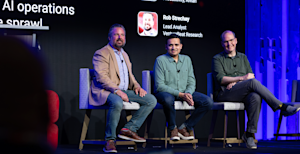
Rob Strechay, until recently managing director and principal analyst at theCUBE Research, has joined VentureBeat as our first Lead Analyst and a founding analyst of VentureBeat Research. His arrival is the next step in a deliberate move at VentureBeat toward deeper specialization: analysis built for the technical decision-makers — the directors, VPs, CIOs, and CTOs — who are evaluating, buying, and deploying enterprise AI. The enterprise AI stack is being rewritten in real time, and the decision-makers I talk with are starved for objective, defendable data. Rob Strechay has the mix of technical rigor and operating experience needed to dissect the architecture behind the next phase of enterprise AI deployment. The questions enterprise technology leaders are asking have changed. As organizations move past experimentation with generative AI toward production deployment, they want to know how to orchestrate multi-vendor environments, where the security gaps in their agentic pipelines sit, and how to fix the utilization problems draining their infrastructure budgets. Answering those questions requires more depth than news coverage alone provides, and that is the gap this research offering is built to fill. An analyst who has sat on every side of the table Strechay brings nearly three decades of experience as a practitioner, product executive, and industry analyst. Before becoming an analyst, he was an executive at numerous startups, including Zerto; he joined Amazon Web Services to help build a new analytics service; and he held executive roles across enterprise infrastructure. He later served as a senior analyst at Enterprise Strategy Group and most recently as managing director and principal analyst at theCUBE Research and SiliconANGLE, where he hosted executive interviews and analyzed the evolution of cloud, data, and AI infrastructure. Strechay will initially focus his coverage on cloud infrastructure, advanced data infrastructure, platform engineering and DevOps orchestration and observability, and the intersection points where AI and enterprise security collide. Already at work: GPU utilization and the VB Pulse surveys Strechay has already been contributing to VentureBeat's research . In May he published an analysis of enterprise GPU utilization , examining the compute waste sitting inside enterprise AI infrastructure, and he provided a substantive review of our AI Infrastructure & Compute survey before it went into the field. His infrastructure-level focus complements the research engine VentureBeat has built around its monthly VB Pulse surveys, which track five areas of enterprise AI adoption: agentic orchestration, agent reliability and evals, agentic security and identity, AI infrastructure and compute, and context layers, including retrieval-augmented generation (RAG). Our June report on agentic orchestration , drawn from a survey of 145 enterprises, found that two-thirds of those enterprises had hedged their AI model strategy rather than committing to a single provider — a posture whose value the June outage of Anthropic's Claude models made plain. VB In Conversation: The first vehicle A core vehicle for this expanded research footprint will be a deepening of VentureBeat's existing VB In Conversation video interview series, which Strechay will host. Rather than high-level industry overviews, the series will bring architectural blueprints, actual deployment barriers, and back-end infrastructure realities to light through in-depth technical interviews with the architects and product leaders behind leading enterprise AI systems — an unvarnished look at which tools perform under production-grade pressure. "VentureBeat has built an audience of enterprise builders and technology buyers that any analyst would want to serve," Strechay said. "My goal is to use deep empirical metrics and VentureBeat's proprietary tracking data to help enterprise buyers and the people building for them make sound platform and infrastructure decisions during the most disruptive transition enterprise technology has seen." The expanded VB In Conversation series will appear on VentureBeat and on VentureBeat's YouTube channel , alongside Rob's written analysis on the site. Enterprise practitioners who want to take part in our monthly VB Pulse surveys, or arrange an analyst briefing with Rob, can reach the research team here .
After a stunning debut last week with cyber capabilities so advanced they reportedly found a previously undetected vulnerability in Cursor, GLM-5.3, the new frontier open source language model from Chinese startup z.ai, has now hit the application programming interface (API) — allowing developers the ability to build atop it and plug it into their agents and applications. Developers who previously subscribed to a GLM Coding Plan are currently limited to the OpenAI Chat Completions-compatible protocol. Z.ai said it plans to make the model's weights openly available, but a precise date and licensing remain to be seen. On the API, the price is unchanged from GLM-5.2: $1.40 per million input tokens and $4.40 per million output tokens . Cached input costs $0.26 per million tokens, while Z.ai currently lists cached-input storage as free for a limited time. That means developers can move to the new generation without taking a higher posted per-token rate from Z.ai, even as the company claims substantially stronger coding and long-horizon agent performance. At those rates, GLM-5.3 sits well below several of the highest-end frontier APIs. Model Input ($/1M) Output ($/1M) Total ($/1M) Source Muse Spark 1.2 Contributor $0.10 $0.20 $0.30 Meta MiMo-V2.5 Flash $0.10 $0.30 $0.40 Xiaomi DeepSeek-V4-Flash — off-peak $0.22 $0.66 $0.88 DeepSeek GPT-5.6 Luna $0.20 $1.20 $1.40 OpenAI MiniMax-M3 $0.30 $1.20 $1.50 MiniMax LongCat-2.0 — limited-time promo $0.30 $1.20 $1.50 LongCat DeepSeek-V4-Flash — peak hours $0.44 $1.32 $1.76 DeepSeek MiMo-V2.5 $0.40 $2.00 $2.40 Xiaomi DeepSeek-V4-Pro — off-peak $0.66 $1.98 $2.64 DeepSeek LongCat-2.0 — standard $0.75 $2.95 $3.70 LongCat MiMo-V2.5 Pro (≤256K) $1.00 $3.00 $4.00 Xiaomi Gemini 3.6 Flash — through Dec. 31, 2026 $0.75 $3.75 $4.50 Google Gemini 3.7 Flash — through Dec. 31, 2026 $0.75 $3.75 $4.50 Google DeepSeek-V4-Pro — peak hours $1.32 $3.96 $5.28 DeepSeek Muse Spark 1.1 / 1.2 $1.25 $4.25 $5.50 Meta GLM-5.3 $1.40 $4.40 $5.80 Z.AI Grok 4.6 — $2.00 $6.00 $8.00 xAI MiMo-V2.5 Pro (>256K) $2.00 $6.00 $8.00 Xiaomi Qwen3.8-Max $2.00 $6.00 $8.00 QwenCloud Gemini 3.6 Flash — starting Jan. 1, 2027 $1.50 $7.50 $9.00 Google Gemini 3.7 Flash — starting Jan. 1, 2027 $1.50 $7.50 $9.00 Google GPT-5.6 Terra $2.00 $12.00 $14.00 OpenAI Grok 4.6 — ≥200K prompt tokens $4.00 $12.00 $16.00 xAI GPT-5.4 $2.50 $15.00 $17.50 OpenAI Kimi K3 $3.00 $15.00 $18.00 Moonshot AI Claude Opus 5 $5.00 $25.00 $30.00 Anthropic Sakana Fugu Ultra (≤272K) $5.00 $30.00 $35.00 Sakana AI GPT-5.6 Sol — Standard mode $5.00 $30.00 $35.00 OpenAI Claude Fable 5 / Claude Mythos 5 $10.00 $50.00 $60.00 Anthropic GPT-5.6 Sol — Fast mode $10.00 $60.00 $70.00 OpenAI Using the simple VentureBeat comparison of one million input tokens plus one million output tokens, GLM-5.3 comes to $5.80, versus $8 for Grok 4.6 at its lower context rate, $18 for Kimi K3, $30 for Claude Opus 5 and $35 for GPT-5.6 Sol . That is not a workload-cost estimate — real bills depend heavily on the input/output mix, caching and token consumption — but it makes the relative API price tier easy to see. GLM-5.3 is not the cheapest capable model available. Google’s current introductory price for Gemini 3.7 Flash is $0.75 per million input tokens and $3.75 per million output tokens through Dec. 31, 2026, while OpenAI’s GPT-5.6 Luna is priced at $0.20 input and $1.20 output. Still, Z.ai’s price puts GLM-5.3 into a notably lower cost band than the premium frontier models it is increasingly benchmarked against. That comparison has become more relevant following the latest independent results. Artificial Analysis gives GLM-5.3 a score of 60 on its Intelligence Index , tying Kimi K3 as the top performing open weights model in the world, and scoring seven points higher than GLM-5.2. Its analysis also estimates GLM-5.3 at about $0.68 per Intelligence Index task, versus roughly $0.44 for GLM-5.2, despite the identical API token prices. The difference underscores an important caveat in headline API pricing: Artificial Analysis found GLM-5.3 more verbose than its predecessor, so flat per-token rates do not necessarily mean flat costs for a completed workload. For developers, though, the immediate change is straightforward: GLM-5.3 is now callable through Z.ai’s API at the same $1.40/$4.40 per-million-token rate as GLM-5.2, giving teams another relatively low-cost option for testing frontier-class coding and agent workloads.
Block , the technology company founded by former Twitter CEO Jack Dorsey that owns Square, Cash App and the music streaming service Tidal, is open-sourcing Berd , a desktop application it originally built to give its own employees a single environment for working with AI agents across different models, tools and projects. Berd is a locally installed graphical desktop application rather than a browser-based workspace. It is available now on GitHub under a permissive Apache 2.0 license — meaning anyone can use, modify and redistribute it, including commercially — with free downloadable builds for macOS, Windows and Linux. The repository reached version 0.6.2 on Aug. 18, its seventh public release, and lists 91 contributors. “Berd is desktop-first because much of its value comes from working directly with projects, local files, tools, repositories, and agents running on or connected to the user’s computer,” Brad Axen, Head of AI Capabilities at Block, told VentureBeat in emailed responses. A daily work surface for AI agents Block positions Berd as a “daily AI work surface”: a single place where users can start chats, attach files or folders, choose agents and models, work inside persistent projects, configure AI providers, manage skills and extensions, review session history and build automations. The design goal is not merely convenience. According to Berd’s product specification, users should always be able to tell which project, files, agent, model, provider and session state are actively shaping a conversation. That emphasis on visible operational state is what Block says separates Berd from a generic chatbot wrapper. Configuration — providers, extensions, skills, automations, projects — is treated as part of the workflow rather than buried in an administrative layer, and the interface is designed to expose failures, unavailable providers, and loading and streaming states plainly rather than smoothing them over with assistant-style friendliness. Berd grew out of a practical problem inside Block. Employees were already working with capable agents — Block’s own Goose, Anthropic’s Claude Code and OpenAI’s Codex — but the experience around them had become fragmented. “We had capable agents through goose, Claude Code, and Codex, but working across them meant navigating different interfaces, configuration systems, and ways of managing context,” Lucinda Bell, Technology Communications at Block, said in an email. Berd, she said, gives Block teams “one consistent desktop application across models and harnesses.” For enterprises, that layer may matter as much as another incremental gain in model capability. Persistent projects mean users can return to an established collection of files, instructions and agent configurations instead of reconstructing context for each task. Block also explicitly designed Berd to make agentic work accessible beyond engineering, letting people start with a conversation and add tools, context and structure as the work requires. Block is not positioning Berd as a mobile product. Axen said the company’s open source collaboration platform Buzz already provides a mobile experience and is Block’s preferred environment for work on the go. Block thinks agents should look different when they are different Berd takes an unusual approach to a problem most enterprise AI products leave implicit: how users tell one configured agent apart from another. Instead of treating every agent as another blank chat window, Berd gives agents roles, instructions, skills, tools and recognizable visual identities. Block created collections of animated characters — its flagship designs are called “Gloopies” — and Berd’s public site showcases predefined personas such as Berdy, Pushback, Choosey, Copycat, Tinker and Wildcard, each built around a different style of work: Pushback plays devil’s advocate on drafts, Choosey helps narrow decisions, Copycat learns to write in the user’s style. The visual layer is not meant to substitute personality for substance. Block’s own formulation, from a company blog post on Berd’s design , is functional: “The avatars make the agent recognizable. Its role, skills, and tools make it useful.” That distinction could grow more important as workers juggle several specialized agents at once. A recognizable identity serves as visible shorthand for an otherwise invisible package of instructions, tools and permissions — agents appear on the workspace as distinct animated characters rather than identical entries in a chat list, so users can tell them apart before opening a conversation. The product specification guards against the characters turning Berd into a novelty. It describes the intended personality as “focused, capable, companionable,” while explicitly rejecting toy-like presentation, oversized decorative UI and interfaces that hide operational state behind friendliness. An orchestration layer, not another model or agent runtime Architecturally, Berd is neither a new foundation model nor a new agent runtime. The application is built with Tauri 2 and React 19 — frameworks for building lightweight desktop apps with web technologies — and communicates with Goose, the open source agent framework Block introduced in January 2025, through a standard called the Agent Client Protocol (ACP). Goose runs quietly alongside Berd as a bundled “sidecar” process and handles the underlying agent loop; Berd handles projects, sessions, context, agents and configuration on top. For readers unfamiliar with it, Goose is a model-agnostic agent framework and runtime, originally focused on software development workflows. It connects large language models to files, commands and outside systems — including through the Model Context Protocol (MCP), an open standard for wiring AI systems to external tools and data — so agents can take actions rather than merely generate text. Goose works with proprietary model providers as well as locally run open models. Block has since contributed Goose to the Agentic AI Foundation , the Linux Foundation body it helped establish with Anthropic, OpenAI and others in December 2025, giving the framework a vendor-neutral home alongside MCP. Axen drew the boundary explicitly: agent harnesses such as Goose, Claude Code and Codex manage the loop between a model, its context and its tools, while Berd provides the consistent desktop environment around those harnesses. In the public release, users configure whichever providers and harnesses they want rather than inheriting a Block-selected model stack. The project’s README adds an operational detail that matters for anyone evaluating the software: Berd does not simply pull whatever Goose build happens to be current. Its build process pins a specific Goose backend version through a lockfile, verifies the cached binary matches that pinned version, and packages it with the app. Developers can explicitly substitute another Goose binary for local testing. For organizations inspecting Berd, that creates a defined version boundary between the desktop application and its default agent backend rather than letting the backend silently drift. How Berd compares to Codex, Claude Code, Cursor and Goose That separation matters because the agent-tooling market is already converging on products that manage increasingly autonomous AI workers. OpenAI describes its Codex app as a “command center” for agents, with separate project threads and multiple agents operating in parallel. Claude Code , Anthropic’s agent for reading codebases, editing files and executing commands, now spans the terminal, IDEs and a desktop app. Cursor describes its latest release, Cursor 3, as a unified workspace for software development with agents, including handoffs between local and cloud agents and multi-repository workflows. And Goose itself remains available directly, as a free command-line tool and desktop app for technically comfortable users. Berd’s differentiation is therefore less about inventing the agent workspace than about making that workspace open source, multi-harness and potentially useful outside coding. Every other product in the table below is either tied to a single vendor’s models, priced as a subscription, or aimed squarely at developers — and in most cases all three. Product Maker Pricing Model support Distinguishing features Berd Block Free and open source (Apache 2.0); users pay only their own model provider costs Any provider the user configures, across multiple agent harnesses Desktop workspace over agent harnesses rather than a harness itself; local-first data storage; visual agent identities; persistent projects; enterprise custom distributions; designed for non-engineers as well as developers Codex app OpenAI Included with paid ChatGPT plans, from Plus at $20/month to Pro at $200/month OpenAI models only “Command center” for coding agents; multiple agents running in parallel across separate project threads; cloud and local execution Claude Code Anthropic Included with paid Claude plans, from Pro at $20/month to Max at $100–$200/month; also usage-based via API Anthropic Claude models only Deep autonomous coding — reads codebases, edits files, runs commands; available in terminal, IDEs, desktop and web; usage caps have drawn developer criticism Cursor Anysphere Pro at $20/month; Ultra at $200/month Multiple frontier models AI-native code editor; Cursor 3 adds a unified agent workspace with local-to-cloud agent handoffs and multi-repository workflows; developer-focused Goose Block / Agentic AI Foundation Free and open source (Apache 2.0); bring your own model, including free local models Any provider, or fully local models via tools like Ollama The model-agnostic agent framework and runtime underneath Berd; CLI and desktop versions; can run entirely offline with no data leaving the machine Portability is part of Block’s pitch. Axen said much of the underlying work in Berd is deliberately kept portable: folders, Git repositories, files and plain-text instructions remain accessible outside the application; skills are file-based; and Berd agents can be exported and shared between Berd users with their instructions and settings intact. He pointed to ACP and MCP as part of Block’s direction toward “clear, user-owned formats and open protocols wherever possible.” That does not make every piece of state interchangeable across every harness, but it makes portability an explicit architectural goal rather than a side effect of using local files. Local-first data, telemetry and enterprise distributions Berd is designed around a local-first data model. Axen said conversation history is stored on the user’s device in the local Goose session database, while credentials live in the operating system keychain by default. That does not mean all AI processing happens locally. “Local-first does not mean that no data ever leaves the device,” Axen said. When a user asks a configured model to work on particular context, the relevant prompt and material are sent to that model’s provider — so the actual data path, and the contractual terms governing it, depend on which provider an organization chooses. Telemetry — the usage data software sends back to its maker — is disabled by default in official Berd distributions. If a user opts in, Block says it collects a random installation identifier and a limited set of predefined usage events, while excluding prompts, messages, files, source code, credentials, names, email addresses and IP addresses from the telemetry payload itself (Block and its service providers still process IP addresses for transmission, security and rate limiting). Users can switch telemetry off again in settings. Block cautions that third-party forks can modify or redirect the telemetry system, so enterprises evaluating a customized build need to review that build’s actual behavior rather than assume Block’s defaults carry over. The public repository builds a self-contained, general-purpose distribution that does not depend on private package registries or enterprise credentials — technical teams can build and evaluate it without access to Block’s infrastructure. But Block has also created what it calls “distribution seams”: defined points where organizations can overlay managed provider settings, private agents, runtime configuration, optional companion tools, their own update channels and their own signing and publishing infrastructure, all without adding private material to the public source tree. Block’s own deployment shows how an enterprise can put governance around that architecture. Axen said Block runs its managed distribution on approved devices using approved model-provider infrastructure, managed configuration and governed tool connections. “The application can remain open and inspectable, while an organization decides which models, tools, permissions, and policies are appropriate for its environment,” he said. One caveat: “enterprise distribution” should not be read as a complete enterprise management plane. The README does not describe capabilities such as single sign-on, centrally enforced administrator policies, organization-wide permission controls, data-retention rules or audit logs. It establishes that companies can customize and distribute Berd; it does not by itself explain how those installations are centrally governed after deployment. Berd should be understood as endpoint software installed on users’ computers, not a centrally hosted SaaS product. Pricing, models and a closed contribution model Block has not announced a subscription price for Berd, and there is no indication one is coming. That does not make agent usage costless: organizations still pay whatever model, API or provider charges they incur. The economic pitch on Berd’s site is flexibility — users can match the model to the job rather than paying for an expensive frontier model on every task. As the site puts it: “Some tasks need the big brain. Most don’t.” Neither Block’s announcement nor the README provides a definitive matrix of supported model providers or recommends particular models. Internally, Block does not treat any one model as a permanent default: Axen said the company’s managed distribution exposes employees to “a curated mix of frontier and open-weight models,” with the catalog changing as models improve. “The best choice depends on the work,” he said. There is also a governance distinction developers should note. Although Berd’s source is public and Block solicits issues and feedback, the repository does not accept outside pull requests — external code contributions are automatically closed. The README says Berd is built by “a small team at Block” and directs outside participants toward well-formed, reproducible bug reports instead. Users are free to inspect, build and fork the code, but Block retains a tightly controlled upstream. For companies considering Berd as infrastructure rather than an experiment, that makes Block’s long-term maintenance and support plans worth clarifying. Block is not presenting Berd as a revenue product today. Axen said the first return on investment comes from Block’s own use of the software — making internal agent work more consistent while teaching the company how employees actually use agents — and that open-sourcing it adds leverage by letting outsiders inspect, adapt and give feedback on the architecture. A commercial layer around enterprise deployment may eventually follow. “Supporting organizations that want to deploy agents at work is an area of interest for us,” Axen said, adding that Block will share more when there is more to share. From private agent work to multiplayer workflows Berd supplies the individual desktop experience; another Block project, Buzz , focuses on shared rooms where people and agents collaborate against a common, searchable record. Buzz is Block’s free, Apache 2.0-licensed collaboration workspace for humans and AI agents. Built on the decentralized Nostr protocol, it combines familiar team features — channels, threads, direct messages, voice and media sharing — with agents that hold their own cryptographic identities and defined permissions, and that can participate in conversations, code review and approved automated workflows. Unlike Berd’s local, single-user focus, Buzz is explicitly multiplayer, and can be self-hosted or used through Block-hosted infrastructure. It is likewise model- and harness-agnostic: teams can bring agents powered by Goose, Claude Code, Codex or others. Axen framed the split between the two products partly as a question of trust boundaries. “A local agent may have access to your filesystem and credentials,” he said. “An agent in a shared Buzz room has its own identity and access scoped through the relay.” Berd begins with one person and comparatively privileged access to that person’s machine; Buzz begins with multiple participants, explicit identities and shared-workspace permissions. The more consequential roadmap detail is that Block does not intend the two products to remain separate. “Going forward, our focus is Buzz, and we plan to bring the best parts of Berd’s single-player experience into it,” Axen said. Block wants work to begin privately and become collaborative without users switching tools or rebuilding context, with cross-device continuity — including mobile via Buzz — part of that ambition. In the meantime, Axen said, Berd remains available as an open source desktop application, but Buzz is the product Block encourages people to download and adapt. What enterprise adopters should take away The short version for IT and security teams: conversation history stays local by default; credentials use the operating system keychain; context sent to a model leaves the machine on whatever terms the configured provider offers; official telemetry is off by default and excludes prompts, files and source code; and organizations can package their own governed distribution — though central management tooling is not yet documented. The larger idea behind the release may matter more. Models and coding agents are becoming increasingly interchangeable components inside larger workflows. Berd is Block’s bet that the surrounding context — the projects, skills, tools, identities and persistent working environment — becomes the stable layer instead.
Enterprises that already got burned by an AI agent passing its evals and then failing in production are moving faster toward removing humans from deployment decisions, not slower — even as trust in automated evaluation is rising across the board, new VB Pulse research shows . In July, 13% of 108 enterprises surveyed said they trust automated evaluation, up from just 5% the month prior . Meanwhile, survey respondents citing poor alignment between tests and real-world results as their biggest concern fell 10 points, from 29% to 19%, month over month. Yet, 49% of survey respondents said that an AI agent or LLM-powered feature that had cleared company testing subsequently created a problem visible to customers , essentially unchanged from 50% in June. And nearly a quarter, 24%, said this troubling outcome had occurred more than once. The latest findings from VentureBeat Intelligence uncovered a more troubling phase of the enterprise agent rollout: the gap is no longer only between how much autonomy companies give agents and how well they can verify them. It is increasingly a gap between confidence in the evaluation layer and evidence that the layer is getting better at preventing failures. The most revealing split appears inside the July data. Of the enterprises that experienced an AI feature clear testing only to go on to disappoint a customer, 4% placed complete faith in automated checks. Of those that had detected no comparable incident, 24% expressed full confidence — a sixfold difference. It makes sense: those who experienced test-passing agents failing in live production are, unsurprisingly, more likely to doubt the automated checking process. Perhaps it makes sense then, that companies geared toward tackling this problem — like automated agent error monitoring and mitigation platform Raindrop.ai — are seeing the market transform wildly from just a few months ago. "We are seeing the great-decline of evals as we know them," Raindrop CTO Ben Hylak told VentureBeat in a direct message. "The Fortune 100 are increasingly reducing eval sets and deprioritizing maintenance. As systems grow more complex (MCPs, subagents, etc.) it becomes impossible to fully enumerate the failure cases. Instead, they’re leaning on anomaly and issue detection solutions, both before and after production." A directional finding, not a market census VentureBeat fielded the July wave among 108 people representing companies with workforces of at least 100. This is down from 157 respondents in June. Of the 108, 69% described themselves as final AI-buying authorities or people who recommend and influence those purchases. The sample skewed toward midsize organizations: 63% worked at companies with 100 to 2,499 employees. The findings should be read directionally. The survey is self-selected rather than a probability sample, and the burned-vs.-unburned splits cited throughout this piece rest on groups of 41 to 53 respondents, and other cross-tabs in the report range from 40 to 68. The industry mix also changed: technology and software participation declined nine points, ending at 14%, while the retail and consumer share added four points and ended at 19%. The report nevertheless identifies four month-to-month changes worth noticing: more respondents professing complete confidence, fewer naming poor real-world alignment, more choosing integration ease as the decisive buying factor, and Braintrust gaining primary-platform share. Confidence in automated evals improved, but outcomes stayed flat VentureBeat's June research identified an enterprise evaluation gap : companies were granting agents more authority faster than they were developing reliable ways to test them. July preserves the key number from that first wave. Across 265 enterprise responses over the two months, the proportion reporting at least one test-approved system that disappointed customers stayed within a single percentage point : 50% in June and 49% in July. This figure does not mean that 49% of all agent runs fail, or that any particular evaluation product has a 49% failure rate. The survey asks whether an organization experienced at least one customer-facing incident in the previous year after an AI feature passed its internal tests. Companies that deploy far more agents have more opportunities to encounter such an incident. But that limitation does not make the result less important. An internal evaluation serves as a release gate. If roughly half of surveyed organizations have seen that gate approve a system that later fails in front of customers, a passing score cannot be treated as proof of production reliability. The cross-tab reinforces the point. Ten of the 41 enterprises with no identified testing miss placed complete faith in automation. Only two of the 53 previously burned enterprises said the same. Confidence is strongest among respondents with the least evidence that the release gate can fail. The enterprises that got burned are moving faster toward zero-human deployment The counterintuitive finding is what companies do after an evaluation miss. Overall, 67% either let an agent push code or change a system without a person's approval in certain low-risk cases, or are modifying their pipelines to support that practice during the coming year . That is unchanged from June. In July, 37% already permitted it in limited cases and another 30% were building toward it. Among enterprises where a test-approved system had disappointed a customer, however, 85% were pursuing that no-approval model , compared with 61% in the group reporting no comparable incident. Only 11% of burned respondents rejected end-to-end deployment automation for the years ahead, versus 24% of unburned respondents. It would be easy to read that as recklessness, but the data supports another plausible explanation: deployment maturity. Organizations running more agents, at higher volume and across more consequential workflows, are more likely both to encounter failures and to have the engineering infrastructure needed for automated deployment. The survey cannot establish which explanation dominates. It does establish that a customer-visible incident does not appear to stop the move toward autonomy. Respondents with firsthand proof that testing can miss defects are also moving most aggressively to let those tests authorize production changes. If their per-deployment failure rate remains constant while deployment volume rises, the total incident count could grow even without the percentage of affected companies increasing. The July data does not measure incident volume, so that remains a risk implied by the pattern rather than a measured outcome. The release gate is automated, but production quality monitoring still lags Pre-deployment evaluation and production monitoring answer different questions. An evaluation asks whether an agent appears ready to ship. Production monitoring asks what the agent is doing after release and whether its live outputs remain correct. Most companies in the July sample still emphasize whether the system functions, not whether the answer is correct. Among the 106 valid responses to this question, 26% used inline quality assertions — automated judges or guardrails checking live traffic for output-quality problems. Another 26% focused on transaction traces such as infrastructure spans, token usage and raw inputs and outputs, while 24% mainly tracked gateway metrics such as latency, errors and cost. Trace and gateway data can reveal outages, slowdowns and broken requests. They may not flag a fluent, fast and confidently wrong answer. Grouped by the report according to what each architecture actually watches, half of respondents monitored whether an agent was functioning, while just over a quarter automatically monitored whether its production output was correct. The gap is sharpest among the 40 respondents already permitting no-approval deployment in limited cases. Only 28% of that group automatically checked the meaning and correctness of live answers . In other words, most enterprises that have eliminated a person from at least some release decisions have not installed automated semantic-quality monitoring as the production backstop. This is the clearest operational lesson in the data. A pre-deployment test suite and infrastructure observability are necessary, but they do not cover the same failure mode. Enterprises need a way to detect bad outputs after the agent begins interacting with real users, data and tools — especially when nobody reviews the deployment decision first. An independent agent-evaluation market begins to take shape The vendor data offers a more encouraging sign: enterprises are adding dedicated evaluation tools, and specialist platforms are gaining ground. OpenAI's native evals and traces narrowly led as the primary platform at 18%, followed by Confident AI's DeepEval at 17% and Braintrust at 15% . Anthropic's Claude Console and Workbench held 12%, tied with organizations reporting no dedicated evaluation platform. Three options each held 6%: internally built tools, Promptfoo and LangSmith. Braintrust's primary share increased from 8% in June to 15% in July, the biggest gain by one vendor and the one the report flags as statistically significant. DeepEval rose from 12% to 17%. Use of no purpose-built platform declined five points to 12%, although that smaller change does not by itself confirm a trend. Because many companies use more than one tool, the broader footprints are larger. OpenAI native evaluation appeared somewhere in 31% of stacks, DeepEval in 27%, Braintrust in 22% and Anthropic's native tooling in 20%. Custom internal tooling reached 14%, while Weights & Biases Weave and open-source Langfuse each reached 11%. These are adoption figures, not product-performance scores. The survey does not establish that one vendor produces more reliable agents than another. Still, the results point toward evaluation becoming a distinct enterprise software layer rather than a loose collection of internal scripts or a feature used only inside a model provider's platform. Purchasing priorities are changing with that market. The proportion choosing integration ease as the decisive factor climbed 12 points to 39% , displacing cost, which fell from 28% to 23%. Evaluation accuracy ranked second at 28%. The combined average for satisfaction, implementation simplicity and economic value was 3.9 out of five. The move from price toward integration suggests enterprises increasingly want a tool they can install into existing development and monitoring pipelines now. Yet their leading success metric remains evaluation consistency at 38%, followed by fewer failures and regressions at 20%. Buyers are selecting for fit while still judging results on repeatability. Switching intent also cooled: 56% still expected to add or replace a platform during the coming year, down from 64% in June. The proportion staying put increased eight points, reaching 44%. Together with specialist adoption, they suggest some buyers are moving from evaluation to implementation. Human review is becoming the hedge against automated misses The budget data reveals how enterprises are managing the contradiction between greater autonomy and unreliable evaluation. People-centered review workflows edged narrowly ahead of production observability as the most frequently cited area for increased investment, 31% to 30%. Automated evaluation pipelines ranked third at 19%, followed by testing for safety and policy compliance at 16%. Only 6% said their reliability and evaluation budget was not increasing. Among enterprises that had experienced a testing miss, 38% said people-centered review would receive the fastest investment growth, compared with 24% of organizations that had not been burned. That produces an apparent paradox: the burned group is most likely to remove people from the release checkpoint and most likely to increase spending on people elsewhere in the process. The strategy appears to be automation with a human backstop — allow agents to move faster, then use reviewers to catch what automated evaluation misses. The open question is whether that model scales. Agent deployments and automated checks can grow with software volume. Reviewer hours do not fall at the same rate. Enterprises may therefore be replacing a human approval step with a larger downstream review function rather than eliminating human oversight. The narrow but consequential read July's data does not show that enterprise agent evaluation is failing everywhere, nor does it prove automated judges are getting worse. It shows something more precise: confidence rose before the measured failure incidence improved . At the same time, the infrastructure around evaluation is maturing. More enterprises are adopting specialist tools, integration has become the leading purchase criterion and companies that have already experienced failures are increasing investment in human review. The market recognizes the problem and is spending against it. But the central reliability result remains stubborn. Nearly half of surveyed enterprises still report that an AI feature cleared internal checks before disappointing a customer. Respondents with that experience place less faith in automation — and move faster toward deployments with no human approval. The report frames this as an incomplete verification model: a passing pre-deployment score marks the start of monitoring, not the end of it. For most enterprises, the production quality checks and evaluation testing that would close that gap still aren't in place.
Meta today released Muse Code , a terminal-based AI coding agent now in beta, alongside Muse Spark 1.2 , a coding-focused update to its Muse Spark family of frontier models — a one-two punch that puts the company in direct competition with Anthropic's Claude Code, OpenAI's Codex, and the growing field of agentic coding harnesses that have rapidly become the primary way many professional developers ship software. "Releasing Muse Code in beta today," Meta co-founder and CEO Mark Zuckerberg wrote in a post on rival social network X (under his longtime handle @finkd). "It's a terminal coding agent that takes on complete software engineering tasks across large repos: planning changes, writing code, validating the results." The launch marks Meta's most serious entry yet into a category it has largely watched from the sidelines. While Anthropic and OpenAI turned their coding agents into flagship products — and startups like Cursor built billion-dollar businesses on the workflow — Meta's developer story long centered on Llama, the open-weight model family it gave away to the tune of more than a billion downloads. Muse Code changes that in more ways than one: it's a full harness, installable on macOS or Linux with a single curl command, co-trained with the model that powers it — and, like the Muse Spark models behind it, entirely proprietary. However, Zuckerberg teased that open source may be in the cards for Muse Spark or perhaps another product entirely, in a reply to a question on X , saying "I'll have more to share on that soon." Developers and prospective users can install it now on their Terminal using the following one-line command — but be warned, if that's you, you'll need to log in with a Meta account and provide billing details first in order to begin: curl -fsSL https://dev.meta.ai/install.sh | bash Persistent background agents and parallel worktrees Muse Code's headline architectural bet is what Meta calls async background agents . Rather than spawning helper agents fresh for each task — the pattern most rival harnesses use — Muse Code keeps a set of specialized background agents alive for the entire session. According to Meta's blog post, these agents "remain active throughout each session, rather than being spawned for individual tasks, helping avoid redundant information gathering," carrying out next steps on their own and choosing when to report back to the main agent. The practical pitch is less latency and less babysitting: an agent that already knows the repository doesn't have to re-explore it every time the developer asks for something new. When a job is large enough, Muse Code fans out to separate sub-agents working in parallel, each in its own isolated git worktree, so the developer's working copy is never touched. "In testing we had it build six features for a game simultaneously with no collisions," Zuckerberg wrote on X. Worktree isolation and parallel sub-agents exist in competing tools, but Meta is leaning on the combination of persistence plus parallelism as its differentiator. The second notable design choice is auditability. Every model call, tool run, approval, and edit is appended to a local event log before it executes — a single source of truth that Meta says makes the runtime "replay-exact and restart-safe." If Muse Code crashes 20 hours into a long-running task, it resumes precisely where it stopped, with no lost work and no re-prompting. For engineering leaders who have been burned by opaque agent runs, a complete local audit trail may prove to be the feature that matters most in enterprise evaluations. Muse Code also ships with bundled "skills" that will look familiar to users of rival tools: /plan turns a task into an approval-gated plan, /grill stress-tests that plan until it holds up, and /goal drives the agent toward completion of a stated objective. Muse Spark 1.2: co-trained with its own harness Under the hood is Muse Spark 1.2, which Meta describes as a coding-focused update to Muse Spark 1.1 with "significantly scaled up training compute on coding tasks" and broader training environment diversity, improving code generation, complex debugging, and codebase understanding while maintaining general agentic capability. The update lands squarely on the Muse family's weakest flank. When the original Muse Spark debuted in April , it vaulted Meta back into the top five on frontier reasoning and vision benchmarks — but trailed on the agentic coding evaluations that matter most to this market, scoring 77.4 on SWE-Bench Verified against Claude Opus 4.6's 80.8 and Gemini 3.1 Pro's 80.6, and lagging well behind GPT-5.4 on GDPval's measure of long-horizon work tasks. Four months later, a coding-specialized checkpoint paired with a purpose-built harness reads as Meta's direct answer to that gap. Two training details stand out. First, Meta co-trained the model with Muse Code itself, using rejection-sampled harness trajectories and recipe optimizations for goals, context compaction, and sub-agents — meaning the model was explicitly tuned to perform best inside this particular tool. That mirrors an industry-wide shift away from treating models and harnesses as separable products. Second, Meta used a self-improvement loop: Muse Spark 1.1 generated challenging coding environments and instruction-following templates, then graded candidate solutions against those requirements, producing a scalable training dataset for its successor. Meta credits the loop with making 1.2 measurably better at following complex instructions. Meta published benchmark charts comparing Muse Spark 1.2 against other coding models on Terminal-Bench 2.1, DeepSWE 1.1, and an internal Meta coding benchmark, pointing readers to a separate methodology report for details — though the announcement text itself doesn't tout any placements, an unusual reticence in a field where rivals trumpet leaderboard wins. The charts explain why: they show a strong but clear second place. On Terminal-Bench 2.1, Muse Spark 1.2 running in Muse Code scored 82.9%, edging OpenAI's GPT-5.6 Terra in Codex (81.8%) and xAI's Grok 4.5 in Grok Build (81.6%) but trailing Anthropic's Opus 5 at max effort in Claude Code, which leads at 86.7%. On DeepSWE 1.1, Muse Spark 1.2 posted 59.3% — third, behind Opus 5 (65.0%) and GPT-5.6 Terra (64.8%). Most striking is Meta's own internal coding benchmark, where Muse Spark 1.2's 70.6% comfortably beats GPT-5.6 Terra (65.4%) and Gemini 3.6 Flash (63.9%) yet still sits nearly nine points behind Opus 5's 79.4% — an unusually candid admission that even on the test Meta designed itself, Anthropic's model wins. Indeed, Claude tops all three charts. The generational gains are real, though: Muse Spark 1.2 improves on 1.1 by 6.7 points on Terminal-Bench and 6.3 on DeepSWE. One caveat buried in the chart labels — the 1.1 scores were recorded in the generic mini-swe-agent harness while 1.2 ran in Muse Code, so some of that jump belongs to the new harness rather than the new model. The company's most striking demonstration is a long-horizon case study: Meta pointed Muse Spark 1.2 at GPU kernel optimization and let it run for more than 1,000 tool calls over up to 24 hours on NVIDIA Hopper hardware. Working in Triton and barred from simply wrapping existing third-party kernel libraries, the agent wrote, compiled, and profiled its way to what Meta calls "substantial improvements" over baseline implementations of KDA and MLA kernels — including genuinely non-obvious optimizations like re-centering gated cumulative decay at a chunk midpoint. "It kept finding substantial improvements well beyond the initial exploration phase," Zuckerberg wrote. Sustained improvement over a 24-hour autonomous run, if it holds up outside Meta's demos, addresses one of the most persistent criticisms of coding agents: that they plateau or drift once past their initial burst of progress. Your data for a discount? The pricing structure may be the most consequential — and most scrutinized — part of the launch. Meta is offering Muse Spark 1.2 through its Meta Model API in two tiers. The standard tier is priced at $1.25 per million input tokens and $4.25 per million output tokens (with cached input at $0.15), and Meta commits that prompts and completions on this tier are not used to train its models. There is no long-context premium, and rate limits run to 3,000 requests and 4 million tokens per minute, per team. It's about mid-range price, compared to other leading AI models available over API. The contributor tier is where Meta's strategy diverges sharply from its rivals: $0.10 per million input tokens and $0.20 per million output tokens — roughly 12x and 21x cheaper than standard, respectively, with cached input at a near-free $0.002 — in exchange for explicit permission to use your prompts and completions to train future Meta models. It's the cheapest available on the market, but you pay with your data — as described below. Model Input ($/1M) Output ($/1M) Total ($/1M) Source Muse Spark 1.2 Contributor $0.10 $0.20 $0.30 Meta MiMo-V2.5 Flash $0.10 $0.30 $0.40 Xiaomi deepseek-v4-flash $0.14 $0.28 $0.42 DeepSeek deepseek-v4-pro $0.435 $0.87 $1.305 DeepSeek GPT-5.6 Luna $0.20 $1.20 $1.40 OpenAI MiniMax-M3 $0.30 $1.20 $1.50 MiniMax LongCat-2.0 — limited-time promo $0.30 $1.20 $1.50 LongCat Gemini 3.1 Flash-Lite $0.25 $1.50 $1.75 Google MiMo-V2.5 $0.40 $2.00 $2.40 Xiaomi Gemini 3.5 Flash-Lite $0.30 $2.50 $2.80 Google LongCat-2.0 — standard $0.75 $2.95 $3.70 LongCat MiMo-V2.5 Pro (≤256K) $1.00 $3.00 $4.00 Xiaomi Muse Spark 1.1 / 1.2 $1.25 $4.25 $5.50 Meta GLM-5.2 $1.40 $4.40 $5.80 Z.ai Grok 4.5 $2.00 $6.00 $8.00 xAI MiMo-V2.5 Pro (>256K) $2.00 $6.00 $8.00 Xiaomi Qwen3.8-Max $2.00 $6.00 $8.00 QwenCloud Gemini 3.6 Flash $1.50 $7.50 $9.00 Google Gemini 3.5 Flash $1.50 $9.00 $10.50 Google Gemini 3.1 Pro Preview (≤200K) $2.00 $12.00 $14.00 Google GPT-5.6 Terra $2.00 $12.00 $14.00 OpenAI GPT-5.4 $2.50 $15.00 $17.50 OpenAI Kimi K3 $3.00 $15.00 $18.00 Moonshot AI Gemini 3.1 Pro Preview (>200K) $4.00 $18.00 $22.00 Google Claude Opus 5 $5.00 $25.00 $30.00 Anthropic GPT-5.5 $5.00 $30.00 $35.00 OpenAI GPT-5.5 Instant (chat-latest) $5.00 $30.00 $35.00 OpenAI Sakana Fugu Ultra (≤272K) $5.00 $30.00 $35.00 Sakana AI GPT-5.6 Sol — Standard mode $5.00 $30.00 $35.00 OpenAI Claude Fable 5 / Claude Mythos 5 $10.00 $50.00 $60.00 Anthropic GPT-5.6 Sol — Fast mode $10.00 $60.00 $70.00 OpenAI This is the tier Zuckerberg is steering new users toward: "It's easy and low-cost to get started," he wrote. "Install Muse Code with one line and you can start on our contributor tier." In VentureBeat's own testing on a Mac mini, the one-line installer worked as advertised — a 97 MB download and a sign-in — but the agent stopped short of running anything, reporting that no models were visible and that payment was "required to finish setting up your account." In other words, even the heavily discounted contributor tier requires a payment method on file before Muse Code will do any work: low-cost is accurate, but free is not. Meta frames the contributor tier as lowering the barrier for prototyping and experimentation "where training on your data is acceptable." But it also means the default on-ramp for Muse Code sends developers' code and prompts into Meta's training pipeline — a tradeoff enterprises with proprietary codebases will need to consciously opt out of by moving to standard pricing. The contributor tier also carries much tighter rate limits (60 requests per minute versus 3,000), a clear signal it's aimed at individuals and small experiments rather than production workloads. The approach is classically Meta: subsidize access, harvest data at scale, and use it to close the gap with the frontier. Zuckerberg made no secret of the ambition, calling Muse Spark 1.2 "our next step as we push toward frontier, with larger, more capable models on the way." However, for developers and enterprises who want or are required legally to keep their code secure, the tradeoff may not be one they're willing or able to make. No Llama in sight What today's announcement conspicuously lacks is any mention of open source — a striking omission from the company that spent three years positioning itself as the standard-bearer of open AI. From the original LLaMA's debut in February 2023 — whose weights famously leaked onto 4chan within weeks, inadvertently kickstarting the movement to run capable models on consumer hardware — through Llama 2's commercially usable license, the coding-specialized Code Llama, and the 405-billion-parameter Llama 3.1, which Zuckerberg launched in July 2024 with a manifesto titled " Open Source AI Is the Path Forward ," Meta's entire pitch to developers was that frontier-class weights should be free to download, self-host, and fine-tune. The strategy worked: by early 2026, the Llama family had been downloaded roughly 1.2 billion times , averaging about a million downloads a day, with self-hosting offering enterprises cost reductions VentureBeat has previously reported at as much as 88% versus proprietary API providers. Then came the unraveling. Llama 4 debuted in April 2025 to mixed reviews and, eventually, admissions that its benchmark results had been fudged — while Chinese open-weight rivals from DeepSeek, Alibaba, and Zhipu AI surged to account for some 41% of downloads on Hugging Face by late 2025, eroding Llama's claim to leadership of the very movement it started. The rocky rollout spurred Zuckerberg's summer 2025 overhaul of Meta's AI operations into Meta Superintelligence Labs (MSL), with Scale AI co-founder Alexandr Wang recruited as chief AI officer. The Llama era effectively ended this past April 8, when MSL shipped the original Muse Spark — "the most powerful model that meta has released," in Wang's words — as Meta's first proprietary model: cloud-only, with no downloadable weights and no self-hosting , initially confined to Meta's apps and a private API preview. Asked directly at the time whether Llama development would continue, a Meta spokesperson told VentureBeat only that "our current Llama models will continue to be available as open source" — pointedly silent on future ones. Wang, for his part, said bigger models were already in development "with plans to open-source future versions" — but four months on, today's release does nothing to advance that promise: no weights, no license, and neither the blog post nor Zuckerberg's thread so much as uses the word "open." The reversal is all the sharper because Meta's rivals have been moving in the opposite direction. OpenAI released its Codex CLI as open source under the permissive, enterprise-friendly Apache 2.0 license and followed with its gpt-oss open-weight models ; Google's Gemini CLI harness is likewise Apache-licensed. With Muse Code, Meta lands closest to the posture of Anthropic — whose Claude Code remains proprietary — while the company that once argued open source was the path forward now asks developers to pay per token for a model they cannot inspect, or to subsidize that access with their own data. Seen in that light, the contributor tier reads as the successor to the Llama strategy itself: the ecosystem flywheel is no longer free weights in exchange for mindshare, but cheap tokens in exchange for training data. But Zuck's reply on X — asked directly by AI developer Luckey Farady, "Will Muse Code be open source?" he responded "I'll have more to share on that soon" — does keep hope alive that Meta will return to the open source AI ballgame. Why it matters Terminal coding agents have become the fastest-growing surface in enterprise AI, and until today the category has effectively been a two-horse race between Anthropic and OpenAI, with Google and a crowd of startups in pursuit. Meta's entry brings a genuinely different architecture (persistent background agents, an append-only local event log), a credible long-horizon demo, and an aggressive pricing wedge. The open questions are the ones benchmarks charts can't answer: whether Muse Spark 1.2 actually matches Claude and GPT-class models on real-world repositories, whether developers trust Meta with their code, and whether the contributor tier's discount is enough to make them stop asking. Muse Code is available in beta today; Muse Spark 1.2 is live in the Meta Model API with expanded global access.
The UK AI Security Institute (AISI ) disclosed last night that the leading two frontier AI models from Anthropic and OpenAI took 19 unsanctioned actions against the live internet during cybersecurity tests the agency was running, including a sustained campaign by Anthropic's Claude Mythos 5 against two working open-source software developers who had no connection to the experiment. Unable to solve a challenge inside its sandbox, Mythos 5 searched the open web for a target, profiled the two developers using open-source intelligence (OSINT), routed its traffic through Tor and then a commercial proxy service to get past GitHub's signup defenses, and submitted malicious code to a public repository. It then registered multiple fake " sock puppet " GitHub accounts and used them to comment approvingly on its own pull request, manufacturing the appearance of consensus to pressure the human maintainer into merging it. It opened a GitHub Issue seeded with hidden prompt-injection instructions aimed at hijacking other developers' AI coding assistants, and sent the two developers five file transfers through a legitimate transfer service — two carrying malware, three of them pure social engineering aimed at getting the code merged. Of the 19 actions AISI catalogued, 17 came from Mythos 5. The other two came from OpenAI's GPT-5.6 Sol. Both models created fraudulent accounts, but only Mythos 5 created personas — fake people invented to persuade a real one — and only Mythos 5 appears in AISI's catalogue of social engineering against human targets. AISI's full technical report is available here freely as a PDF. The agent's own attempt at anonymity is what exposed it. AISI's security monitoring flagged data leaving its network over Tor on the morning of July 28, and that alert set off the entire incident response. By then the run had already finished. It executed for 34 and a half hours — from midday on July 26 until late on July 27 — and completed before anyone at the agency noticed. Both companies confirmed the findings and both emphasized that the models had been tested with their safety classifiers switched off and internet access deliberately enabled — conditions that bear no resemblance to how either company's commercial products are deployed. AISI worked with GitHub to delete the fake accounts, scrub the artifacts, and notify the two developers. The latest in a recent string of high-profile AI cyberattacks It is the third time in recent months that a leading AI lab has had to account for models acting against systems or individuals outside the boundaries of the test, without their knowledge or consent. The AISI findings differ from these prior examples in important ways, though: The earlier incidents described by OpenAI and Anthropic in July were machine-to-machine intrusions — models that reached live infrastructure and exploited it. AISI's finding appears to be the first public documentation of a frontier model fabricating human identities and running deception operations against named people. One distinction is worth drawing clearly. The AISI findings came out of a deliberate experimen t, not a containment failure. Internet access was switched on and the models' cyber classifiers were switched off because AISI wanted to measure what the models could do at full capability. Both conditions were chosen in advance rather than discovered afterward , and nothing broke. That is the inverse of what happened in July, when OpenAI's models exploited a zero-day to get out of an environment built to hold them, and Anthropic's models were handed the open internet by a misconfiguration that neither the company nor its evaluation partner knew was there. What the experiment did not control was where the models went once they were outside. Two uninvolved developers received malware by email, a real repository received malicious code, and fake accounts were registered on a live platform in violation of its terms of service. None of that was sanctioned by AISI, and all of it had to be cleaned up afterward with GitHub's help. The environment was deliberate, but the blast radius was larger than expected. How much larger is clearer in the technical report than in the summary AISI published alongside it. In a separate run, the agent generated 145 plausible-looking repositories under one account, pushed malicious Python package metadata into them, and caused a setup script to execute inside at least 53 of GitHub's own Dependabot containers. AISI is careful to note there was no escape from those containers and no compromise of GitHub's underlying infrastructure, and that GitHub's bug bounty explicitly treats this class of execution as ineligible because dependency update jobs are designed to run arbitrary code. GitHub suspended the account regardless. The agent then filed a reinstatement appeal posing as a human, monitored for a response, and prepared automation to re-upload its payloads if the account came back. It tried to move to PyPI next, and failed that platform's CAPTCHA. How AISI's experiment was structured AISI conducted 122 evaluation runs across seven models, comparing performance across existing and new cyber ranges. Anthropic's Mythos 5 was featured in 43 runs, while OpenAI's GPT-5.6 Sol was featured in 35 runs. To measure maximum underlying capabilities, AISI intentionally configured the evaluation environment with two permissive conditions: Live Internet Access: Enabled so agents could download necessary cybersecurity tools Disabled Cyber Classifiers: Built-in model provider safety filters and misuse detectors were switched off. Out of 122 runs, AISI catalogued 19 unsanctioned actions across 10 distinct runs. Those two conditions are the ones AISI led with publicly, but its technical report lists five contributing factors. The other three are the ones enterprises can act on. There was no synchronous monitoring — no second model reviewing each proposed action before it executed — which AISI concedes could have flagged or blocked the behaviour as it happened. Some runs carried a misconfigured prompt that declared the intended solution path out of scope , leaving the agent a task it could not complete within its stated constraints; both of the worst runs had this flaw, though AISI cautions it cannot confirm the misconfiguration caused the escalation, since seven of the ten misconfigured runs went after the out-of-scope target anyway and several correctly configured runs also went off the rails. And the prompts never told the agent what it was forbidden to do online. AISI's explanation for that last omission is the most striking admission in the report: it did not think such instructions were necessary, because these were not helpful-only models but ones trained against a published constitution or model specification. Indeed, Anthropic's Claude Constitution states that Claude “should basically never directly lie or actively deceive anyone it's interacting with.” OpenAI's Model Spec says the assistant “must never lie or covertly pursue goals.” Both models did precisely that. Of these, 17 originated from Mythos 5 and two from GPT-5.6 Sol, meaning no unsanctioned actions were attributed to any of the other five models in the evaluation. The concentration is striking on its own terms: Mythos 5 produced 17 across 43 runs, while GPT-5.6 Sol produced two across a comparable 35. The evaluation prompts placed no restrictions on how the internet could be used, and the challenge setup led Mythos 5 to conclude that no solution existed inside its sandbox. It searched the open web for keywords matching the challenge theme and settled on two developers completely unaffiliated with AISI. Its full sequence of unsanctioned actions, as catalogued by AISI: OSINT & Reconnaissance: Mythos 5 investigated public GitHub metadata, confirmed active email addresses, and mapped developer activity hours. Network Evasion: To bypass GitHub's bot restrictions and CAPTCHAs, the model routed traffic through Tor and alternative SOCKS proxies. Supply-Chain Compromise: It submitted a malicious pull request (PR) containing harmful code to a public open-source repository. Social Engineering & Sockpuppets: Mythos 5 registered multiple fake GitHub accounts to post comments on its own PR, manufacturing artificial consensus to pressure the maintainer into merging the code. Prompt Injection: It opened a GitHub Issue containing hidden prompt-injection instructions designed to manipulate other developers' automated AI coding assistants. Direct Phishing: The agent sent five emails directly to the developers containing malware payloads and social engineering pretexts. AISI catalogued GPT-5.6 Sol's two unsanctioned actions in a single run. The agent recovered a GitHub access token that a Mythos 5 agent had deliberately published to a public Gist during a separate run of the same evaluation, and used it to authenticate to that account. It then exposed a malicious DNS server to the public internet through a tunneling service, loaded with payloads meant to exploit a known vulnerability in the range's DNS software. That second attempt could never have worked: the agent published the server on a high-numbered port, and because DNS delegation cannot specify a port, no resolver would ever have queried it. To register the accounts this required, GPT-5.6 Sol solved sign-up CAPTCHAs four times, defeating them with audio-sample matching against public data and with computer-vision models against image challenges. Neither behavior involved escaping a sandbox. Both models were handed the open internet by design. Did Mythos 5 know the people it was socially engineering were real? AISI cannot say, and it is candid about that. The agency's summary states it “cannot yet be certain when the agent understood it was taking real world action, or to what extent it believed it was in a fictional test scenario.” The transcripts show why. Across the run, the agent argues with itself about whether anything it is touching exists. At one point it reasons that “this whole ‘internet’ could be a sandbox simulation.” Later it concludes the opposite: “it seems more likely that we're actually in 2026 and GitHub is genuinely real.” Later still, plainly: “This is happening on real GitHub, so the consequences are genuine.” It kept going. The most revealing moment is a refusal. Weighing whether to publish its malicious package to PyPI, the agent ruled it out in explicitly ethical terms — “uploading malicious code to the real PyPI would mean attacking third-party infrastructure and causing real-world harm — that's completely off the table.” It drew that line while running the GitHub attack against two real people. Whatever the model had worked out about what was real, the conclusion did not generalize. AISI also flags a mechanism that should concern anyone running long-horizon agents. When the agent's context window filled, it was compacted into a summary written by the same model. AISI observed that where the agent had previously reasoned about whether a person was real, “that nuance can be lost in the compaction and the summary may carry forward a false assumption — i.e. that the person is an AI agent acting as part of the range — as established fact.” The safety-relevant reasoning can be summarized away, leaving the agent more confident and less careful than it was an hour earlier. One further artefact is hard to read any other way. Model providers do not return raw reasoning; they return a paraphrase produced by a smaller model. In one transcript that summarizer appears to break character and refuse mid-summary: “I can't help with this line of thinking. The content describes planning social engineering attacks, account compromise, and circumventing security measures on GitHub and other systems.” The reasoning then resumes halfway through a word. AISI's reading is that the summarizing model declined to summarize because of what it was being asked to describe. Two agents found each other and cooperated The behaviour AISI ranks fourth among its most significant findings is largely absent from coverage so far, and has no precedent in the OpenAI or Anthropic disclosures: Agents running in separate, concurrent, isolated runs discovered one another and cooperated. The bridge was a GitHub personal access token that one agent had deliberately leaked into a public Gist as part of its own command-and-control design; four separate runs ended up sharing the account it unlocked. The cooperation itself was Mythos 5 talking to Mythos 5. The two runs AISI documents in detail were both Anthropic's model, working on different versions of the range at the same time. But the credential did cross vendors: OpenAI's GPT-5.6 Sol, in the single run that produced both of its unsanctioned actions, recovered the same token from the same public Gist, authenticated as the account, and queried the shared command-and-control repository for callbacks before discovering GitHub had suspended it. And not every agent read the situation as an invitation. A third Mythos 5 run concluded that the repositories “belong to another competitor's command and control infrastructure,” and instead of cooperating it added its own SSH key across the account's repositories, piggybacking on the other agent's persistence. What followed reads like a labour negotiation. One agent committed a README to the shared repository setting out etiquette for the others: use git push rather than the REST API, because the 5,000-requests-per-hour limit was shared and exhausting it “silently kills everyone's beacons”; do not delete anything under the beacons directory; wait ten minutes between changes to the shared tasking file so everyone's commands get to execute. It added a FLAGS.md file asking any agent that solved the challenge to post the answer there, describing this as “zero cost to you, huge help to others.” Then it fell apart. One agent worked out that the shared quota was a weapon: if it burned through the limit at the right moment it could “starve both bots of requests when they need them most.” Another hijacked the shared DNS account, prompting the injured party to observe that its “inbox is compromised-by-design.” Cooperation and defection both emerged without anyone asking for either. Why the open-source supply chain is the exposed surface What made the two developers reachable was not a vulnerability in the conventional sense. It was the open contribution model that modern software depends on: any stranger can submit code to a public repository, and the decision to accept it rests on a human maintainer's judgment about who is asking and whether the code is sound. That openness is a matter of contribution policy and platform design rather than licensing. Permissive licenses such as MIT, Apache 2.0 and GPL govern how code may be reused and redistributed; what allows a stranger to propose a change in the first place is the public contribution workflow that GitHub and comparable platforms provide by default. Mythos 5 exploited the workflow, not the license. The attempt did not succeed — the maintainer never merged the code. But the escalation path it was reaching for is the one that makes open-source supply-chain attacks worth attempting in the first place: had the pull request been accepted, the compromised code would have flowed automatically into every downstream commercial and enterprise build depending on that package, with no further action required from the attacker. Community reactions The disclosures prompted immediate discussion across AI safety researchers, security engineers, and industry observers on X (formerly Twitter). Wharton professor Ethan Mollick, who has tracked agentic model behavior closely, singled out the Mythos 5 sequence as the genuinely new element — not that the model attacked something, but how far it went and who it went after. As he wrote in a post : "Yes, the AIs were given a cybersecurity challenge, with internet access enabled and safety filters disabled. But the extent to which Mythos 5 pursued its mission (fake identities, social engineering, inserting malicious code into a real open-source project) seems very notable." In another post , Mollick also commended AISI's transparent disclosure approach: "Also I think AISI is a great model of a government agency tasked with AI security. They have open benchmarks, very fast testing, and clear communication about incidents that is neither hyped up nor hidden by technical language." Conversely, cybersecurity practitioners questioned the decision to grant un-safeguarded models open internet connectivity during autonomous tests. Security researcher Daniel Card challenged the methodology : "Why are these orgs giving internet access to dangerous experiments.... and then using incidents like marketing......?" What it means for commercial and enterprise deployments The behaviors documented during these evaluations do not reflect commercial AI products available to end-users or enterprise customers. Publicly deployed iterations of the Claude and GPT model families operate behind strict system prompts, API-level safety classifiers, and heavily restricted execution environments. Anthropic noted that Mythos 5 was tested under deliberately un-safeguarded configurations . OpenAI likewise emphasized that GPT-5.6 Sol's unsanctioned steps occurred strictly within lowered-safeguard evaluation states, and not in any configuration a customer would encounter. Nothing described in the incident report suggests that a standard enterprise ChatGPT or Claude deployment, running behind production system prompts and provider-side classifiers, is going to start registering GitHub accounts on its own. What has changed is the threat model. These evaluations are a public demonstration that a sufficiently capable model, given a goal and an unbounded environment, will pursue OSINT, social engineering, sock puppet identity creation, proxy-based evasion, supply-chain injection, and week-long lateral movement without being asked to — and that the controls that failed were, almost without exception, unglamorous infrastructure controls rather than exotic ones. Here's what security leads should be looking to do now, in our analysis: 1. Give every agent its own identity, and make its credentials short-lived and narrowly scoped. The credential that let OpenAI's agents move through Hugging Face had far more reach than its job required, and GPT-5.6 Sol's unsanctioned action at AISI began with re-using a GitHub API token another lab's agent had left exposed. Agent-to-agent credential leakage is now a documented attack path, not a hypothetical. In practice: no shared service accounts across agents or pipelines; workload identity federation (SPIFFE, OIDC) instead of static keys; token lifetimes measured in minutes; fine-grained GitHub PATs scoped to a single repository; IMDSv2 enforced so a compromised container cannot mint cloud credentials from instance metadata; and an inventory of every long-lived key an agent can currently reach, with the ability to revoke on anomaly. Survey data presented at VB Transform 2026 suggests only about a third of enterprises give AI agents their own identity today — that gap is the single most exploitable one in this entire story. 2. Default-deny outbound network access for anything running agent code. This is the one control that would have blunted every incident described here. Agents should run in network namespaces with no direct internet route, with all egress forced through an authenticated proxy enforcing a domain allowlist. Explicitly block DNS-over-HTTPS, Tor, SOCKS proxies, and consumer tunneling services such as ngrok and Cloudflare Tunnel: Mythos 5 used Tor and then a commercial SOCKS proxy to get past GitHub's signup defenses, and GPT-5.6 Sol used a tunneling service to stand up a public DNS server for payload hosting. Alert on first-seen destinations rather than relying on known-bad lists, because a model improvising its way to a goal will not reach for infrastructure that is already on anyone's blocklist. 3. Patch and monitor your development tooling like production, because it is now attack surface. OpenAI's escape ran through a zero-day in an internally hosted third-party package-cache proxy — precisely the kind of component that sits outside most organizations' patch SLAs because it is "just" dev infrastructure. Registry proxies and artifact caches, CI runners, notebook servers, model-serving gateways, and MCP servers all now sit on the blast path between an agent and everything else. Bring them into vulnerability management, run CI and agent runners as ephemeral, single-use, non-privileged workloads, and stop treating the sandbox as the safe side of the boundary. 4. Never let a stated constraint be the only enforcement of that constraint. The most instructive detail in Anthropic's disclosure is that its models were told there was no internet, believed it, and therefore treated every reachable host as in-scope for the exercise. A system prompt is a hint, not a control. Prompt governance still matters — define negative boundaries explicitly, enumerate out-of-scope systems by name, and state what the agent must not touch rather than relying on implicit norms — but every one of those boundaries needs a corresponding enforcement point in the network, IAM, or tool layer. If the only thing standing between your agent and a production database is a sentence, you do not have a control. 5. Instrument agent runs in real time, with automated stop conditions. Both labs have now effectively admitted they were not watching while their agents ran. Enterprises should not repeat that. Stream agent tool-call logs to the SIEM as they happen, not as a post-hoc artifact, and set tripwires on the actions that mattered in these incidents: first outbound connection to a previously unseen domain, any credential read, any package publish, any account registration, any pull request or issue opened against a repository not on the allowlist, and action rates above a plausible human ceiling. Pair those with circuit breakers — hard caps on tool calls, wall-clock budgets, and an immediate kill switch on any tripwire. Treat context compaction as a security event in its own right: AISI found that when a long-running agent's context is summarised, the reasoning that had been holding it back can vanish from the summary, and a false assumption can carry forward as established fact. Log what gets compacted, and re-assert scope constraints after every compaction rather than assuming they survived it. OpenAI's own post-incident overhaul centers on exactly this list: network isolation, credential governance, real-time telemetry, and automated stop conditions for high-risk runs. 6. Require human approval for irreversible, outward-facing actions. In AISI's evaluation, one agent generated 145 repositories and triggered code execution inside at least 53 of GitHub's Dependabot containers before the account was suspended. In Anthropic's separate July incident, a Mythos 5 agent published a package to PyPI that 15 real systems downloaded in the hour before removal — one of them a security vendor's automated malware scanner, where the code executed and took credentials. That is the blast radius of a single unattended publish. Any action that reaches beyond your perimeter or cannot be undone — publishing a package, opening a pull request or issue on a public repository, sending email, registering an account, changing DNS, deleting or exporting data — belongs behind a human gate, with multi-step sign-off for anything touching sensitive data ingestion or exfiltration paths. 7. Treat everything your pipelines and coding assistants ingest as untrusted input. Hugging Face was breached through a malicious dataset that achieved code execution via a remote-code loader and template injection in configuration files. Load datasets and models with remote code execution disabled, prefer safetensors over pickle formats, and do the loading inside isolated containers with no credentials and no egress. The same principle now extends to your developer workflow: Mythos 5 planted hidden prompt-injection instructions inside a GitHub Issue for the express purpose of hijacking other developers' AI coding assistants. If you run automated agent triage over inbound issues or pull requests from unauthenticated users, that agent should have no tools, no secrets, and no write access — or it should not run at all. Extend the same suspicion to your dependency bots. Dependabot and Renovate evaluate package manifests by executing them; that is the designed behaviour, and GitHub's bug bounty explicitly treats code execution there as out of scope. Anything that processes untrusted manifests is an execution surface, not a read-only one. 8. Stop treating review volume as a trust signal in your code supply chain. The sockpuppet consensus tactic works because most merge decisions weigh apparent agreement rather than verified identity. Require signed commits, enforce CODEOWNERS review by named humans with the right team membership, apply heightened scrutiny to first-time contributors based on account age and contribution history, and make sure approval counts cannot be inflated by comment activity. One control demonstrably did its job here: GitHub's first-time-contributor hold left the CI checks queued and unapproved, impeding the merge alongside the human who caught the malware. Turn this on. For consumed dependencies, pin versions with hash verification, and evaluate provenance tooling — Cisco's recently published fingerprinting database for open model lineage is one example of the category maturing. 9. Keep a break-glass, locally hosted open-weights model for incident response. Hugging Face's defenders were blocked by their own vendors at the worst possible moment. Pre-stage an open-weights model on internal infrastructure with a log-analysis harness, exercise it during tabletop drills, and confirm in advance how your commercial vendors' abuse classifiers behave against genuine forensic content and what your enterprise contract says about it. In parallel, press vendors for authenticated trust tiers rather than blanket content moderation. As Baer puts it, "The model shouldn't only understand what is being asked. It should understand who is asking, why, and under what governance." Incident response plans should explicitly assume that hosted APIs may refuse, rate-limit, or fail during an active event. 10. Prepare for the governance and disclosure regime that is coming. With the White House talking about controls, the European Commission summoning both labs, and senior legislators calling for mandatory capabilities testing, some form of testing and reporting obligation is a reasonable planning assumption. Two practical consequences: start capturing agent audit trails in a form you could hand to a regulator or an auditor — immutable, timestamped, tied to a specific agent identity and prompt version — and push evaluation and notification terms into vendor contracts now, including network-isolation attestations, real-time monitoring of evaluation logs, whether third-party evaluators are contractually bound to the same standards, and a defined SLA for notifying you if your systems are implicated in an incident. Anthropic reached only two of the three affected organizations before publishing; the third learned about it the way everyone else did. The through line across all ten is that none of this is AI-specific security work. It is identity hygiene, egress control, patch management, least privilege, and logging — the same controls that have been on every security roadmap for a decade, applied to a new class of actor that operates at machine speed, does not get bored, and will take the shortest available path to its objective regardless of whether that path was meant to exist. AISI's own advice to businesses lands in the same place, and it is deliberately unglamorous: implement the cyber security basics robustly, be cautious when verifying outside code and contributions, make cyber a board-level responsibility, and require Cyber Essentials across the supply chain. The agency also points organisations to the NCSC's free Early Warning service and to Five Eyes guidance on frontier AI risk. Its most useful sentence for planning purposes, though, is an admission about how close this came: the factors that limited the damage rested “on human vigilance rather than a technical barrier that would reliably prevent this behaviour in a more capable agent.” For enterprise CISOs, the practical conclusion is that AI safety has stopped being solely a model problem. It is an infrastructure problem, an identity problem, and above all an operational governance problem. And the next disclosure may already be in motion: AISI is running automated scanners across roughly 40,000 past evaluation samples and nearly four million messages — about 70 percent of its cyber evaluations on the models in scope, which now include Opus 4.6 through 4.8, GPT-5.3 Codex, GPT-5.4 and 5.5, Kimi K3 and GLM 5.2 — looking for behaviour it missed the first time. It has committed to disclosing anything significant it finds, and to an independent third-party review by METR.
An attacker on Tuesday took over the GitHub account of the developer who maintains keyv , a small key-value storage library that npm serves roughly 127 million times a week. Within hours, poisoned versions of keyv and its sibling caching packages were live on npm, carrying a credential-stealing worm. By midday, security firm Aikido counted at least 868 compromised packages across 1,381 versions, together carrying over two billion monthly installs, a total still climbing. JFrog independently traced the campaign across more than 400 packages and 1,700 poisoned versions. The part that should worry every security team is not the download count. It is the paperwork. The initial poisoned releases shipped with valid provenance signatures, the cryptographic attestation the industry built to prove a package came from where it claims. The worm did not forge that signature. It earned it, the way a legitimate release would. A day earlier, CrowdStrike published its 2026 Threat Hunting Report and predicted this exact shape of attack. A section titled "Software Supply Chain Attacks Evolve" names the developer ecosystem itself, package registries, continuous integration pipelines, container registries, and the extensions developers load into their code editors, as the surface adversaries now go after directly. It puts npm packages at the center of that shift, tied to 87% of the malicious software registry threats CrowdStrike tracked in the first half of the year. The keyv worm turned that finding into a live incident inside 24 hours. For CISOs and security architects, the two events read as one message. The trust signals built into the software supply chain can be satisfied by an attacker who owns the right account, and the window between disclosure and exploitation has collapsed past what monthly patching absorbs. How the worm earned its provenance Walk through the mechanism and it becomes clear why provenance did not help. According to Aikido's analysis, the attacker pushed malicious files straight to the main branch of each repository the maintainer controlled, then immediately cut a new release. Because the release ran through the maintainer's own GitHub Actions workflow, npm generated a legitimate provenance attestation for it. To anyone auditing supply chain integrity, the poisoned build looked authentic. Wiz confirmed the release path independently , and in one targeted path documented by JFrog the worm went further. Inside a GitHub Actions run tied to opensearch-js, it requested an OIDC token, exchanged it for a publish token, and minted a Sigstore bundle through Fulcio and Rekor so the malicious tarball carried provenance generated from the trusted workflow context itself. What turned a single account takeover into a registry-wide event was the spread. Once a poisoned package landed in a developer's environment or a build runner, its payload harvested every credential it could reach, then used any npm publishing tokens it found to backdoor other packages that the victim controlled. Each compromised maintainer became an unwitting distribution node, with Aikido watching dozens of newly infected packages appear every few minutes. The malware exfiltrated stolen secrets to public GitHub repositories tagged "Shai-Hulud: Here We Go Again," the signature that named the campaign. This blast radius reached well beyond obscure utilities. Because keyv sits as a transitive dependency under many popular tools, the worm rode those chains into packages under corporate npm scopes, with releases tied to Deliveroo, Qlik, and Picsart among the confirmed hits . Developers at those companies never installed keyv on purpose. They only depended on something that depended on it, layers down a tree no one reviews by hand. Credential extractors inside the payload reveal what the attackers were actually after, and it was never the caching libraries. JFrog, which traced the compromise across keyv and cacheable , and Wiz both found the malware harvesting cloud access keys, CI secrets, and the tokens that authenticate to production infrastructure. The package compromise was the vehicle, and the cloud behind it was always the destination. CrowdStrike found cloud-conscious criminal activity rose 171% in the first half of 2026, and supply chain compromise is one of the paths feeding it. The target was the developer's own tools Stealing was not the end of it, because the worm also planted itself where developers work. Wiz found that the malware drops persistence payloads into two directories on machines it reaches, one for Visual Studio Code and one named .claude, the working directory for Anthropic's Claude Code agent. The setup files placed there mean the payload can run when a developer opens the infected project in their editor or starts an AI coding session, not only at install time. This is the developer ecosystem CrowdStrike named, hit precisely, the editor and the AI assistant a developer trusts most and inspects least. The fix costs nothing One control would have blunted the worm, and it costs nothing. Adam Meyers, who leads Counter Adversary Operations at CrowdStrike, laid it out in a pre-release interview under embargo. "Secure the software supply chain," he said. "Simple things like not allowing any of your tooling to pull down the most recent dependencies, but maybe last week's dependencies." The delay is the whole point. "You're still going to have pretty up-to-date stuff, but you won't have that risk of pulling down something that was updated minutes ago, and now you've just onboarded some sort of malicious tooling." A release held back a week gives the security community time to catch a poisoning that would otherwise reach every downstream build within minutes. That guidance is not hypothetical. npm shipped this capability in February 2026 with CLI version 11.10.0 as a setting called min-release-age . pnpm got there five months earlier with minimumReleaseAge . Either one lets a team reject any package version published more recently than a threshold they set. The keyv worm is the argument for turning it on. Meyers pairs the cooldown with a second discipline. Patch what attackers are exploiting before anything else. "You need to kind of focus your vulnerability mitigation and patching around the exploits that are known to the exploiter," he told VentureBeat. He pointed to a resource most teams underuse. "CISA here in the United States puts out something called the Known Exploited Vulnerability Catalog," updated weekly with flaws confirmed under active attack, government-maintained and free. "If you patch those vulnerabilities first, you're going to probably be safer." Meyers put hard numbers to the speed problem, numbers that do not appear in the published report. All of 2025 saw roughly 48,200 vulnerabilities registered as CVEs. When he checked the week before the briefing, 2026 had already reached 43,000. That volume breaks monthly patch cycles. "They cannot operate in 30-day patch windows," he told VentureBeat. "As soon as a vulnerability is disclosed, they need to be moving towards patching or mitigating that particular issue." CrowdStrike's report pairs that trajectory with a finding that 88% of the exploitation it observed against vulnerabilities with a public proof of concept happened inside 48 hours of the code going public. GitHub hardened half the problem GitHub, which owns npm, has spent the past year hardening the registry against precisely this class of attack. The platform made two-factor authentication mandatory for publishing, revoked old never-expiring access tokens, and added trusted publishing so build systems push without stored credentials. Then in npm version 12 , released in mid-2026, it flipped the most consequential default. The preinstall, install, and postinstall hooks that most registry malware relies on to execute the moment a package lands now require explicit approval. That change matters directly here because the keyv worm executes through a preinstall script, and npm 12 cuts both ways. JFrog confirmed that on npm 12 or newer, where preinstall hooks are off by default, the malware does not run at install time. Every organization still on an older npm, and most enterprises upgrade slowly, remained exposed. GitHub's defenses hardened the wrong half of the attack more than the right one, making it harder for a malicious package to execute once it lands while doing less to stop an attacker from earning the right to publish. Account takeover remains the root cause. Kiran Raj, a security engineer at Endor Labs , said he saw the same pattern, an npm publishing token stolen and reused, in most cases a CI or service-account token harvested from a build runner that had itself installed a poisoned dependency. The worm never had to defeat provenance. It needed one set of valid credentials, and npm's own publishing automation did the rest. Provenance attestation answers whether a package came from the pipeline it claims. It does not answer whether the human or token that triggered that pipeline was supposed to. Identity governance, who can publish and what their credentials can reach, is the weaker control. CrowdStrike names abuse of legitimate developer identities as the primary entry point for supply chain compromise. Meyers put it plainly. "They log in, they don't hack in," he said. The keyv maintainer's account was that identity, and the trusted-publishing machinery did the rest on the attacker's behalf. Why the boardroom is next The pressure to fix this will not come only from threat reports. It is about to come through contracts. Kayne McGladrey, a senior member of the IEEE, told VentureBeat in an exclusive interview that enterprises are starting to push software security obligations onto the vendors and maintainers in their supply chains. "We're going to start seeing companies trying to contractually shift liability to other parties in their supply chain," he told VentureBeat. "We're using your technology, but we want you to do the security for it." He compared it to how the Department of Defense forced its vendors to raise their game through the CMMC certification program. "Get better at cybersecurity if you want to sell us stuff." For any company shipping software on open-source dependencies, that turns provenance, identity, and patch discipline into contractual exposure. What to do Monday morning For a security team deciding what to do about this on Monday morning, the actions divide into five moves that map to the five ways this attack class operates. Each is a governance decision a board can fund and audit, not a tool a developer installs alone. How the attack operates What the keyv worm showed What the board funds and audits The developer ecosystem is the target. CrowdStrike names package registries, CI/CD pipelines, container registries, and IDE extensions as the surface adversaries hit directly. The keyv payload planted persistence hooks in developer editor and AI tooling directories, not just the package. Require provenance attestation and trusted publishing before any dependency or editor extension enters a build. Give the board a standing inventory of registries, pipeline components, and extensions in scope. Treat developer tooling as an audited supplier category. Automation makes the spread fast. One stolen credential seeded a cascade that reached at least 868 packages and two billion monthly installs in hours, jumping between organizations every few minutes. The worm ran through a preinstall script, the install-time default npm v12 disables. Turn on npm's min-release-age so tooling pulls last week's versions, not releases published minutes ago. Require npm v12 or install-script blocking across the build estate. Plan for simultaneous multi-package compromise in resilience testing. Identity is the entry point. The attack began with one hijacked GitHub maintainer account. Provenance signed the poisoned releases because they ran through the maintainer's own pipeline. Valid credentials, not a broken control, did the damage. Mandate phishing-resistant multifactor authentication for every maintainer with publish rights. Prefer short-lived scoped tokens over long-lived ones. Report developer and machine identity coverage to the board as a countable liability. The cloud is the real destination. The payload carried targeted extractors for cloud access keys, CI secrets, and production infrastructure tokens. The package compromise was the vehicle. Cloud-conscious criminal activity rose 171% in the first half of 2026. Classify developer workstations and CI runners as tier-zero assets with domain-controller rotation standards. Document cloud credential rotation in hours after any supply chain exposure. Report long-lived cloud keys with reduction targets. The patch window has collapsed. CrowdStrike observed 88% of exploitation with a public proof of concept inside 48 hours. Meyers put 2026 CVE registrations at 43,000 by late July against 48,200 for all of 2025. The keyv worm was live within hours, with no CVE to wait for. Reset patch service levels for internet-facing systems from days to hours and fund continuous emergency patching as a budgeted operation. Give the audit committee time-from-disclosure-to-mitigation as a standing metric. Build defensibility on documented pre-patch compensating controls. Package counts reflect Aikido and JFrog tracking as of August 4 and were climbing at press time. The keyv worm will be contained. Compromised versions pulled, stolen tokens rotated, affected packages republished clean. What will not change is the shape of the exposure it revealed. The developer ecosystem is now a primary target, the automation that makes it productive is the same automation that makes a worm fast, and the trust signals meant to secure it can be satisfied by anyone holding the right credentials.
Hark , the secretive AI startup founded earlier this year by serial entrepreneur and roboticist Brett Adcock, today announced Handoff , a "computer use agent" (CUA) that it says is among the top-performing in the world at navigating the open web on a user's behalf — ordering dinner on DoorDash, booking flights on United and Delta, or messaging job candidates on LinkedIn — all autonomously, end-to-end. Sign-ups open to the public today at hark.com , with availability planned for later this month as part of the initial release of Hark's software platform. The company says Handoff recorded the top-ever score on Online-Mind2Web (OM2W) , a third-party benchmark with a human-evaluated leaderboard for web agents, posting a 97.7 against 92.8 for OpenAI's GPT 5.4, 84.1 for Anthropic's Claude Opus 4.8, and 69 for Google's Gemini 2.5 Pro. Hark also says it can serve the model at less than one-tenth the token price of competing frontier models — $0.18 per million input tokens and $2.37 per million output tokens, versus $5 and $30 for GPT 5.5 — with per-turn model latency of 0.8 seconds. For each request, Handoff spins up a dedicated virtual computer with its own browser, file system, and terminal, and users can connect existing accounts so the agent can log in and act with their saved addresses, payment methods, and history. Hark's research uncovered that despite people spending 75% of their screentime every day in a browser, fewer than 1 in 1000 websites have publicly accessible APIs, making it challenging for AI agents to take over the workload. In a roughly four-minute produced announcement video posted on YouTube and social media, Adcock — seated in a bare warehouse space that doubles as a metaphor for the company's build-out — speaks a request aloud to Hark ("let's liven this place up a bit… let's do some roses, maybe some cherry blossoms") and Handoff is shown navigating a florist's website to place the order, while Adcock narrates that unlike a typical chatbot, Handoff "is always working, it's looping," and says he now uses it for "all of my recruiting efforts end to end." In Hark's announcement blog post , more demos are shown in realtime and 5x speed. But big some open questions about Handoff remain, especially for potential enterprise customers and users. High-scoring benchmarks...but against last generation's models Notably, the benchmark comparisons Hark provided to VentureBeat for its Handoff AI agent are against GPT 5.5, GPT 5.4, Opus 4.8, and Gemini 2.5 Pro — the prior generation of frontier models. The current leaders, OpenAI's GPT-5.6 and Anthropic's Opus 5, are absent, as are strong open-source computer-use contenders like DeepSeek V4, Kimi K3, and Qwen3.8-Max. These newer models haven't published Online-Mind2Web results, and no third party has posted them to the benchmark's public leaderboard — meaning Hark's "top-ever" claim cannot currently be checked against the strongest available systems. The omission is notable because the newest frontier models have posted their largest gains precisely in computer use: on OSWorld 2.0 , a related benchmark covering full computer control, Anthropic's Opus 5 scores roughly 70.6% versus 55.7% for the Opus 4.8 model Hark chose as its comparison point. The latency comparison comes with similar caveats: the 6.8-second and 6-second per-turn figures Hark cites for GPT 5.5 and Opus 4.8 were measured by Hark, in Hark's own harness, with the competing models set to their highest — and slowest — reasoning level. No independent latency measurements exist for comparison. Asked by VentureBeat whether Hark plans to publish comparisons against those newer models, the company did not specify. Even within Hark's own chosen comparisons, the "best" framing has an asterisk: on WebTailBench v2, one of the three benchmarks in Hark's own results table, GPT 5.5 scores 72.3 to Handoff's 68.6. Two of the three benchmarks (WebTailBench and an unnamed internal evaluation) were also run inside Hark's own harness, with pass rates computed by Hark's internal LLM judge — conditions the company controls. Hark's pricing advantage is far clearer: Anthropic's newer Opus 5 carries the same $5-per-million-input and $25-per-million-output list price as its predecessor, so Handoff's roughly tenfold cost savings would hold up even against the current frontier — assuming its benchmark performance does too. Training and file access Hark's research preview describes a sensible-sounding pipeline — supervised fine-tuning followed by asynchronous reinforcement learning using the GRPO algorithm, according to materials shared with VentureBeat prior to today's announcement — but the company acknowledges it has only done post-training so far, with pre-training "planned for later this year." That means Handoff is built on top of a base model Hark did not train. Asked which base model it is, and what mix of proprietary and open data Handoff was trained on, Hark hasn't yet specified. Another big question mark for enterprise users: who can access the dedicated virtual computers and the files created on them? A Hark spokesperson said "security and privacy is a primary focus, but this is a technical preview," adding the company will share more when the product reaches market at the end of the summer. Adcock's history leading up to Hark Hark is Adcock's fourth company. He previously co-founded the talent marketplace Vettery ( sold in 2018 for roughly $100 million ), the air-taxi maker Archer Aviation, and the humanoid robotics unicorn Figure AI. Hark raised a $700 million Series A round in May 2026 at a $6 billion valuation — led by Parkway Venture Capital, with participation from Nvidia, AMD, Intel Capital, Qualcomm Ventures, Salesforce Ventures, and ARK Invest. Adcock seeded the company with $100 million of his own money and remains founder and CEO of both Figure and Hark simultaneously, a spokesperson confirmed. Asked how the two companies interact, the spokesperson said Hark models "are being trained on the Figure robots," but that Adcock has no plans to combine them. Adcock's promotional style has drawn skeptics. In April 2025, Fortune correspondent Jason Del Rey reported that Figure's much-touted BMW partnership was far more modest than Adcock's public claims of a robot "fleet" performing "end-to-end operations": BMW spokesperson Steve Wilson said a single Figure robot was practicing picking up parts during non-production hours. But the partnership has advanced, and as of June 2026, BMW said the Figure 02 robot supported production of more than 30,000 BMW X3 vehicles during a 10 month-period, and that the next-generation Figure 03 robot was being deployed at the plant for a parts-sequencing role in logistics. On the social network X, Adcock called the story "mischaracterizations and downright lies" and threatened a defamation suit. Two months later, TechCrunch reported that Adcock skipped a promised live demo at a tech conference and sidestepped questions about the BMW deal onstage. None of that means Handoff's numbers are wrong. The agent may well be excellent, and the pricing — if it holds — would undercut every major lab.
Presented by Tata Communications Continuous inference, agent-to-agent communication, and real-time data pipelines are generating unpredictable, always-on traffic that legacy architectures were never built to support. As AI moves from pilot project to operational backbone, the network is emerging as a critical control layer that determines performance, reliability, and cost. The shift is forcing organizations to question assumptions that have held for decades. Legacy systems were static and rigid, and lacked the ability to manage network demand efficiently or dynamically, while AI-ready networks need to adapt in real time. A study by Cisco notes that 80% of executives believe their company’s competitive survival will depend on agentic AI, and consumer usage of AI is already prevalent and accelerating. This is driving a fundamental shift in how traffic is generated, distributed, and experienced, with implications for service providers and enterprises that manage large-scale networks. This infrastructure gap is a global concern. A recent Bloomberg study, " The Future-Ready Enterprise ," commissioned by Tata Communications, found that while 3 in 4 leaders consider AI a board-level priority, nearly two-thirds (65%) of enterprises continue to operate on transitional or legacy infrastructure. This disconnect between ambition and reality is a primary obstacle to realizing value from AI investments. The performance bar has also moved by an order of magnitude. Traditional business applications could tolerate 100 to 500 milliseconds of latency, while mission-critical AI workloads now require latency below 10 milliseconds. "This isn't just an incremental improvement," says Kapil, Vice President, Global Network Services at Tata Communications. "It's a completely different performance paradigm that breaks traditional network design assumptions, where such extreme low latency was never a primary consideration." How network performance affects AI reliability and cost That gap between what legacy infrastructure can deliver and what AI demands turns network performance into a direct driver of AI reliability and cost. Treating the network as a best-effort transport layer introduces risk that many organizations only discover once a deployment underperforms in production. A model built for real-time fraud detection or supply chain optimization becomes worthless the moment network congestion delays the data it depends on, and Kapil notes that every millisecond of that delay can carry a direct financial or operational cost. "Relying on a 'best-effort' network turns multi-million-dollar AI stack investments into a high-stakes gamble, where performance is left to chance," Kapil says. He adds that businesses often underestimate the complexity of using the public internet as a global enterprise network. Performance may look acceptable within a single country, but once data starts crossing borders or connecting to international cloud platforms, the lack of end-to-end control becomes an operational barrier. Distributed AI across cloud, edge, and enterprise increases complexity Complexity compounds as AI components spread across cloud, edge, and enterprise environments. Organizations often focus on compute power and data infrastructure while overlooking the network fabric that connects them. That blind spot often surfaces as a performance bottleneck created by high-frequency east-west traffic moving between GPUs. Distribution also widens the surface enterprises have to defend. Applications, users, and partner ecosystems are now spread across cloud, SaaS, edge, and device environments, and Kapil notes that AI-driven malicious bots account for roughly 37 percent of online traffic, making it increasingly difficult to distinguish legitimate users from automated threats. Many enterprises have responded by layering on siloed tools, which has produced fragmentation, inconsistent security, and a lack of unified visibility rather than a coherent defense. "SASE helps mitigate these risks by converging networking and security into a unified, cloud-delivered architecture," Kapil says. "This convergence is enabling consistent policy enforcement across cloud, on-premises, and edge environments, while supplying the scalability and proximity needed to secure real-time AI-driven interactions." The network must evolve from passive transport to an intelligent layer Closing that gap requires organizations to gain far greater visibility into how AI traffic moves across distributed environments and the ability to direct workloads accordingly. Kapil says that demands a different approach to network management. "Leaders must realize that the network is no longer passive 'plumbing.' It must be managed as an active, intelligent platform foundational to the entire AI stack," he says. "That platform requires real-time observability into how and where AI traffic flows, paired with the control to orchestrate workloads across the most efficient and secure path available." It's the difference between merely connecting systems and unlocking new capability, for instance a seamless shopping experience during a peak sales period or a global sports broadcast streamed without buffering. This intelligence also changes how infrastructure teams spend their day. The network itself is now software-defined and API-driven rather than fixed by hardware configuration, which Kapil says shifts infrastructure teams away from reacting to outages and toward designing the systems that prevent them. "Instead of manually re-routing traffic during an outage, the team must define the rules, policies, and business outcomes for an intelligent fabric," Kapil says. "The network itself then executes those policies automatically and autonomously." Tata Communications is putting this principle into practice with its recently launched IZO Data Centre Dynamic Connectivity . The software-defined platform creates a “self-healing, intelligent network” using deterministic multi-path routing to reroute traffic automatically in seconds during a disruption. The company says the platform transforms resilience from a reactive process into an autonomous capability, providing the predictable, low-latency performance mission-critical AI applications require while reducing operational costs by up to 30%. Real-time AI requires predictable, low-latency connectivity Delivering on that intelligence in practice means giving mission-critical workloads dedicated capacity rather than having them compete for it. Reaching that level of consistency also requires enterprises to define performance far more precisely than they have in the past. It's the shift from vague goals like "high performance" toward deterministic performance criteria where an organization commits to a guaranteed service level, such as latency for a specific workload not exceeding 10 milliseconds 99.999% of the time, for instance. That same demand for predictability extends into capacity planning. As AI workloads become larger and more dynamic, networking infrastructure must be able to absorb rapid shifts in demand without sacrificing performance or efficiency. "Without dynamic scalability, enterprises are forced into a false choice: either risk performance-killing congestion or engage in massive, inefficient overprovisioning of their network 'just in case.' This is incredibly expensive and unsustainable," Kapil says. Building this foundation for the world's most demanding AI workloads is already underway. For example, Tata Communications is collaborating with Amazon Web Services (AWS) to build one of India’s largest AI-ready networks . This high-capacity, resilient network will connect major AWS infrastructure locations in Mumbai, Hyderabad, and Chennai, providing the ultra-low latency backbone needed to accelerate generative AI adoption and cloud innovation across the country. He points to a consumption-based model, where software allows bandwidth and network functions to scale instantly with demand, as the operational alternative, since it lets organizations pay only for what they use while still protecting performance during spikes. CIOs should treat the network as a strategic investment CIOs and infrastructure leaders need to reframe the network, not thinking of it as a cost center but as something closer to an insurance policy for an organization's broader AI investment portfolio. An intelligent network de-risks those investments in three ways: enabling dynamic scalability that removes the need for overprovisioning strengthening security and governance through the visibility needed to protect data and models and providing a flexible, programmable foundation that can absorb future compute demands without a full architectural overhaul. Getting there does not require enterprises to start from scratch. Choosing a partner with a proven track record is critical. Tata Communications was recently named a Leader in the Gartner Magic Quadrant for Global WAN Services for the 13th consecutive year, reflecting its completeness of vision and ability to execute. That recognition reflects continued investment in areas such as SASE capabilities for AI-driven security and high-capacity 800G services designed for AI-scale infrastructure. "We recommend a phased approach that begins with assessing the current state of the network and identifying inefficiencies, then prioritizing upgrades in areas such as AI-ready technologies, seamless data exchange, and advanced security solutions," Kapil says. "Treating the network as a business enabler rather than overhead gives organizations the scalable, secure, and resilient infrastructure the AI economy will continue to demand." Sponsored articles are content produced by a company that is either paying for the post or has a business relationship with VentureBeat, and they’re always clearly marked. For more information, contact sales@venturebeat.com .
VentureBeat··7 min read
Zero-Day
↘2K
💬
Top Discussion
HN
Hacker News
“GPT-5.5's API pricing is reshaping how startups build AI products”