Matched "Google Developers"Found in Content
TechnologyNews
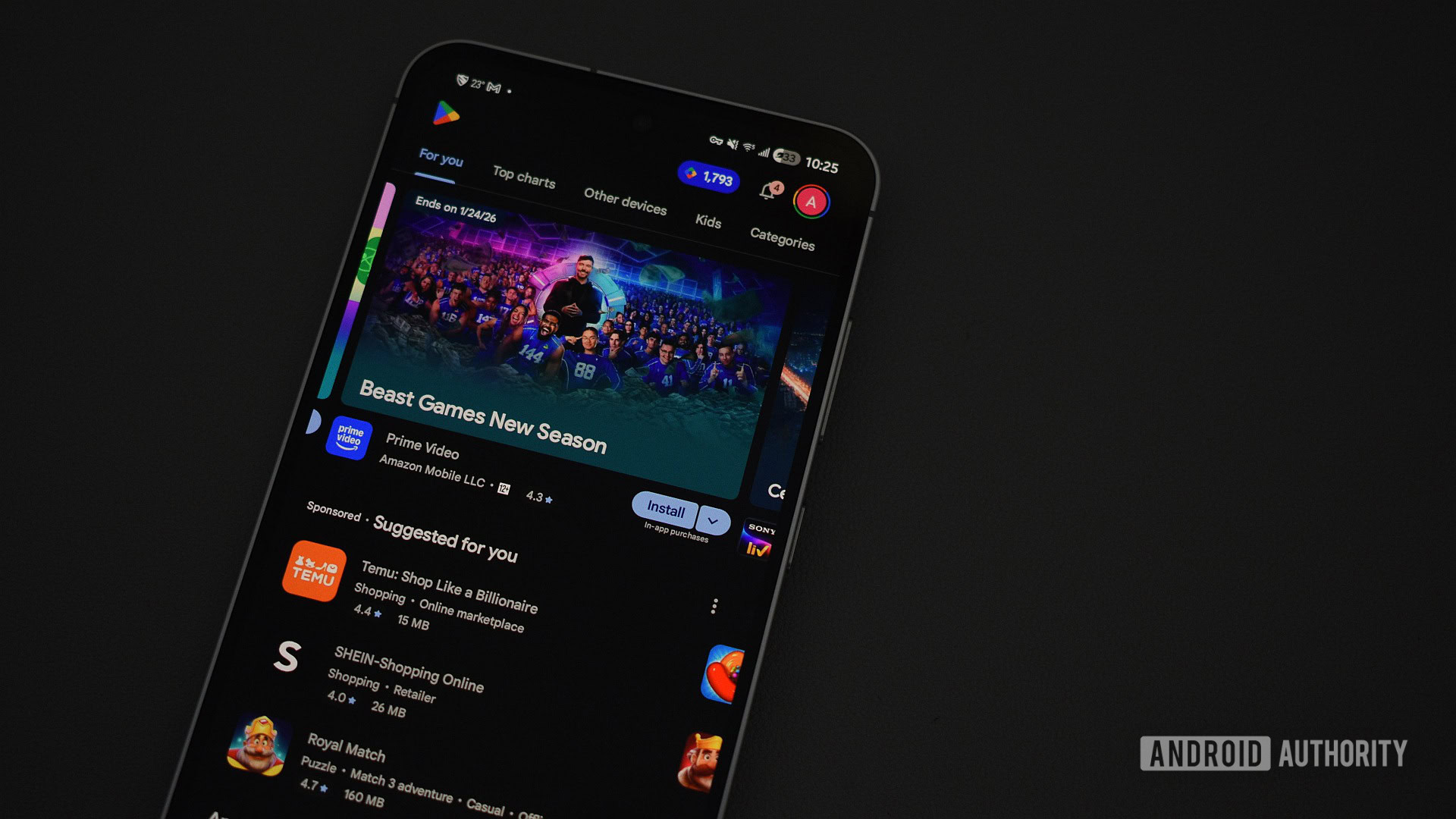
Google's "privacy-preserving" age verification system is coming to the Play Store
Google's new API relies on parents to set age ranges in Family Link.
Ars Technica1 min read
Explore
Showing results for:
"Google Developers"
251 results • Page 10 of 21
Matched "Google Developers"Found in Content
Google's new API relies on parents to set age ranges in Family Link.

Matched "Google Developers"Found in Description
Nimble , a New York City-based tech startup VentureBeat previously covered for its efforts to re-invent web search for enterprises by using multiple AI agents to improve accuracy and depth, is taking another step toward its vision of a world in which agents do most of the web searching instead of us typing and reviewing the results manually. Nimble today launched Web Search Agents , a new retrieval system designed to help AI agents perform more 21% more accurate web research while using significantly fewer tokens — 51% less compared with leading AI search alternatives on comparable, according to the firm. While Nimble did not disclose its specific benchmarking methodology or competitors evaluated, the results underscore a growing trend in enterprise AI: optimizing retrieval has become as important as improving the underlying language models themselves. Nimble's leadership says the product combines self-learning retrieval strategies, proprietary web indexes, and live web access to deliver domain-specific search capabilities that outperform general-purpose web search services for enterprise workloads. "Our research team built self-learning retrieval algorithms that learn a customer's domain," said Nimble CEO and co-founder Uri Knorovich in an interview with VentureBeat. "They find the exact information more efficiently, reduce the amount of multi-hop reasoning required, and lower token usage while improving accuracy." Rather than positioning itself as another general search engine, Nimble is targeting developers building autonomous agents that require continuously updated information from the public web for research, lead generation, competitive intelligence, compliance, and other business-critical workflows. It's also designed to slot in seamlessly to an enterprise's existing systems and workflows. "You can run the agent directly through the Nimble API with zero infrastructure," Knorovich said. "For large enterprises, we're partnering with Microsoft, Oracle, Snowflake, and others so customers can deploy these agent systems inside their own infrastructure." How does it work and stack up to other, existing AI-powered search and agentic systems? Read on to find out. Moving beyond generic AI web search into specialized search agents that fit your enterprise's needs Most AI applications today rely on general-purpose search application programming interfaces (APIs) for search engines and public knowledge bases that return broad collections of files, leaving the language model responsible for determining which sources are relevant. That process often requires multiple retrieval steps, additional reasoning, and significant token expenditure before an agent produces an answer. This is obviously inefficient and raises the cost spent to run AI search looking through irrelevant sources. Nimble argues that before long, every enterprise will need its own methods for searching, retrieving, and validating external information since each enterprise relies on its own distinct preferred sources, signals, and standards of trust. As such, instead of applying one search strategy to every workload, Nimble's Web Search Agents are designed to learn the characteristics of a specific domain and adapt how information is retrieved, providing agents with structured, relevant context rather than forcing them to sift through large amounts of generic search results. "Instead of one generic retrieval model, we build specialized retrieval models for each customer's domain, making them faster, cheaper, and more accurate," Knorovich explained. "A single enterprise can run hundreds of different agents. Each one has its own domain expertise, guardrails, goals, and search algorithm. The optimization starts with the second search, without requiring any setup from the customer." Its goal is not only to reduce redundant retrieval, but also to shorten multi-step research paths and avoid repeatedly sending raw pages through a language model for parsing, resulting in the 51% reduced token figure the company cites. The distinction is particularly relevant for long-running enterprise agents performing research over hours or days rather than answering simple consumer questions. In those scenarios, reducing unnecessary tool calls can significantly lower operating costs while improving answer consistency. That emphasis reflects a broader shift occurring across the AI tooling ecosystem. As foundation models become increasingly capable, infrastructure vendors are competing on everything surrounding the model—including retrieval, orchestration, memory, observability, and governance. Optimizing retrieval for production AI The launch builds on Nimble’s broader strategy of becoming an enterprise web intelligence platform rather than simply a web scraping provider. Earlier this year, the company introduced its broader Agentic Search Platform following a $47 million Series B financing , positioning itself as infrastructure that transforms the live web into structured, machine-readable data for AI systems. The company’s latest release extends that vision with a concept it calls “Harness as a Tool,” which powers its new domain-specialized Web Search Agents. Rather than requiring engineering teams to assemble separate search APIs, browser automation, extraction pipelines, validation logic, memory systems, and orchestration code, Nimble packages those capabilities behind a managed interface. The harness can determine what to search, navigate pages when conventional indexes are insufficient, extract relevant information, validate the results, and return the final context in a form designed for downstream agents. Nimble also says the system retains domain-specific memory and builds proprietary indexes that improve as customers run more searches. "The biggest research breakthrough is adding semantic memory and a caching layer to the agent," Knorovich told VentureBeat. "The agent learns usage patterns and domain expertise over time, so every subsequent search becomes faster and more efficient." As for what domains Nimble can tackle, the company says it can address virtually any knowledge work domain. "We've seen customers build investment banking analysts, competitive intelligence agents for product managers, go-to-market research agents, newsroom monitoring, insurance applications, life sciences research, and supply chain optimization," Knorovich said. "Our customers surprise us every day with new agent use cases." However, for enterprises concerned about data privacy and retention, Knorovich assured VentureBeat that: "Nimble is zero-data-retention by design. Customer queries are never stored in our environment, and when customers deploy semantic memory and self-learning models, that knowledge stays in their own tenant—not ours." Customer deployments point to operational gains Nimble supported the announcement with early customer examples from AI-native software vendors and enterprise users. AI-native CRM company Rox reported achieving a 20× reduction in token costs after adopting Nimble’s retrieval infrastructure while simultaneously improving the quality and completeness of information available to its AI agents. Although the company did not disclose detailed workload measurements or a reproducible baseline, the example illustrates the operational savings retrieval optimization can provide for high-volume agent deployments. Nimble says its infrastructure currently supports more than 90 million searches each day across Fortune 500 enterprises and AI-native companies operating mission-critical workflows where accuracy, completeness, and enterprise control are essential. API, SDK and MCP support target AI builders The platform is immediately available through an API, SDK, and Model Context Protocol (MCP) integration, allowing developers to connect Nimble directly into AI agents regardless of the orchestration framework they use. Developers can use the platform for several categories of web intelligence, including: Low-latency live web search Deep multi-step web research Web crawling Structured dataset generation Domain-specific information retrieval The company also provides documentation and pre-built agents for common web extraction tasks while allowing developers to build custom retrieval agents using natural-language descriptions instead of manually maintaining scraping logic. Nimble is offering two notably different consumption models. Developers can begin with a pay-as-you-go Agent API priced from $0.025 per Web Search Agent request at the listed low-effort setting. Companies that want Nimble to configure and manage custom data delivery can instead buy annual managed plans beginning at $2,500 per month. Where Nimble fits in the emerging agentic search stack Nimble enters a market that has rapidly expanded beyond traditional web search into autonomous research agents capable of planning, browsing, reasoning, and synthesizing information. Products such as ChatGPT Deep Research , Google Gemini Deep Research , Alibaba’s Tongyi DeepResearch , Perplexity , and Sakana Marlin all seek to automate knowledge work that previously required hours—or, in Marlin’s case, potentially weeks—of human research. Rather than competing head-to-head as another end-user research assistant, however, Nimble is positioning itself one layer lower in the AI stack—as the web intelligence infrastructure that powers those agents or custom enterprise applications built on leading foundation models. That distinction reflects an increasingly important architectural shift in enterprise AI. Most “Deep Research” systems optimize the overall research workflow, generating search plans, iteratively gathering information, and producing synthesized reports. Nimble instead argues that the retrieval layer itself has become the primary bottleneck for enterprise AI deployments. If an agent retrieves too many irrelevant pages or performs unnecessary search iterations, token consumption, latency, and operating costs all increase before the model even begins its main reasoning process. "Customers across life sciences, insurance, healthcare, pharma, retail, and digital-native companies are all telling us the same thing: we need to feed our agents with more accurate context, and we need to reduce the amount of tokens every task consumes," Knorovich said. The launch blog makes that argument more concrete by describing how teams frequently rebuild the same retrieval stack themselves. A production agent may start with a search API, then accumulate browser controls, parsers, extraction components, validation steps, memory, caching, evaluations, and custom workflow logic. Nimble is positioning its harness as a managed alternative to that growing engineering burden. In Nimble’s view, improving retrieval before reasoning begins is more valuable than simply giving a language model more documents to analyze. The company’s Web Search Agents therefore adapt retrieval strategies to a particular workload, combining proprietary indexes with real-time web retrieval and task-specific search policies rather than applying the same search algorithm across every domain. That makes Nimble less of a direct competitor to OpenAI’s or Google’s research assistants than to developer-focused retrieval infrastructure such as Exa and Tavily. Those platforms also provide AI-native search APIs and research capabilities, but Nimble differentiates itself by emphasizing self-learning retrieval strategies, proprietary indexing, enterprise governance, managed delivery, and token efficiency for production agents. For organizations building their own AI systems, the distinction could become increasingly important. Foundation models are becoming more capable across the industry, shifting competitive differentiation toward the infrastructure surrounding them—including retrieval, orchestration, memory, observability, and governance. Nimble’s strategy reflects that broader trend, betting that better web intelligence can deliver larger operational gains than incremental improvements in model reasoning alone. Enterprise infrastructure versus AI research assistants The different positioning is also reflected in pricing.While consumer-facing AI research assistants are generally sold as productivity subscriptions for individual users or teams, Nimble is pricing its managed service as enterprise infrastructure designed to power production applications. Its pay-as-you-go API, however, gives developers a lower-cost path to test the underlying agent technology before committing to a managed deployment. Platform Primary audience Primary focus Lowest publicly available price (USD) Nimble Developers and enterprises Managed web retrieval and orchestration infrastructure combining specialized search, browsing, extraction, validation, proprietary indexing, and memory $0.025 per Agent API request (low-effort setting). Managed service starts at $2,500/month (Startup plan, billed annually). ChatGPT Deep Research Professionals, enterprises, and knowledge workers Autonomous multi-step research with iterative browsing, synthesis, and citations $20/month (ChatGPT Plus). Higher limits are available with Pro, Team, Enterprise, and Edu plans. Google Gemini Deep Research Consumers and enterprises Research planning integrated with Gemini, Google Search, and Google's productivity ecosystem $19.99/month (Google AI Pro, U.S.). Higher-capacity AI Ultra and enterprise Workspace offerings are also available. Tongyi DeepResearch Developers and AI researchers Open research model for long-horizon information-seeking and agentic search Free (open source). Users are responsible for their own infrastructure and cloud compute costs. Perplexity Consumers, professionals, and enterprise teams AI-powered web search and cited research Free entry tier. Perplexity Pro starts at $20/month with Enterprise Pro available separately. Exa Developers and AI platform builders AI-native search, content retrieval, and asynchronous research agents Free developer tier (includes monthly credits). Paid Search API pricing starts at approximately $7 per 1,000 requests while Agent runs range from $0.012 to $1.00 per run depending on effort level. Tavily Developers building AI agents Search, extraction, crawling, and research APIs for agents and RAG workflows Free developer tier (1,000 monthly credits). Pay-as-you-go usage starts at approximately $ 0.008 per credit. Sakana Marlin Enterprises, strategy teams, financial institutions, and research organizations Ultra Deep Research for hours-long strategic reasoning and executive-grade reports Pay-as-you-go from approximately $0.61 per credit (¥98/credit) with with 100 credits required per research run (approx $61 per run). The first subscription tier is Pro at approximately $936/month (¥150,000/month) followed by Team at approximately $2,495/month (¥400,000/month) with Enterprise pricing available by quote. The comparison reveals three increasingly distinct markets. ChatGPT Deep Research, Gemini Deep Research, and Perplexity operate primarily as user-facing research assistants. Exa and Tavily provide developer-facing retrieval and research APIs. Nimble and Sakana Marlin occupy more enterprise-oriented territory, but at different layers: Nimble supplies retrieval infrastructure, while Marlin performs long-horizon strategic analysis. Sakana Marlin is particularly useful as a counterpoint. It is positioned as a "Virtual CSO" rather than a search API, running autonomous research loops for as long as eight hours and producing executive-ready reports, references, and supporting materials. Nimble, by contrast, is designed to sit beneath those kinds of systems, supplying the specialized retrieval, browsing, extraction, validation, and orchestration that enterprise agents need to gather reliable external information before reasoning begins. The comparison therefore should not be read as a direct price-to-price evaluation. A $20/month ChatGPT Plus or $19.99/month Google AI Pro subscription buys an individual AI workspace with Deep Research capabilities. Nimble's $2,500/month managed plan funds concurrent production agents, managed ETL, MCP integration, web-page capacity, storage, and hands-free data delivery. Sakana Marlin's approximately $936/month (¥150,000/month) Pro plan pays for extended, compute-intensive strategic research workflows. Each price reflects a fundamentally different product boundary and deployment model rather than simply a different level of AI capability. Why retrieval is becoming the next AI battleground As enterprise AI systems mature, the industry is increasingly recognizing that model quality alone does not determine application performance. Large language models frequently fail not because they cannot reason, but because they lack timely, trustworthy external information. That reality has fueled rapid investment across retrieval-augmented generation, AI-native search, web intelligence platforms, knowledge graphs, browser automation, and agent infrastructure. Nimble’s launch reflects this evolution by focusing less on building another frontier model and more on improving the quality of information flowing into existing ones. Whether the company’s reported 21-point improvement in answer quality and 51% reduction in token usage hold up across a broad range of enterprise deployments remains to be independently validated. The larger strategic bet is that, as frontier models become more interchangeable, companies will differentiate themselves through the data, retrieval policies, trusted-source rules, memory systems, and orchestration layers surrounding those models. Nimble is not trying to build the researcher that sits in front of the user. It is trying to become part of the infrastructure that determines what the researcher can find, how efficiently it can find it, and whether the resulting evidence is complete enough to support production decisions. Web Search Agents are available through Nimble’s API, SDK, and MCP integrations, with a free trial available for developers evaluating the platform.
Matched "Google Developers"Found in Content
Google Play is getting a privacy-preserving way to let apps know how old users are.
Matched "Google Developers"Found in Title
Google is expanding its Play Age Signals API, giving Android developers a privacy-preserving way to tailor experiences based on users’ age ranges.
Matched "Google Developers"Found in Description
Posted by Paul Feng, VP of Product Management, Google Play Providing a safe online experience and protecting users from harm is a top priority at Google Play. We take this responsibility seriously and have been investing continuously to offer baseline protections on our platform while also empowering parents with the tools they need to make decisions for their families. Importantly, we also want to empower Play developers with the capabilities to deliver age-appropriate experiences based on their app's content. To support this, today, we are taking another big step in our ongoing partnership with parents and developers by announcing the expansion of the Google Play Age Signals API to all Play developers globally. Building on current availability in Brazil, we will expand this experience first to users in Australia and Canada by mid-August, with a full global rollout to all users later this year. Empowering developers to create age-appropriate experiences The Play Age Signals API is a privacy-preserving tool that puts parents in the driver's seat allowing them to share their child's age range (e.g. 16-17) directly with apps. It also enables adults to easily share their age when prompted by the app developer. In turn, developers receive the signals they need to tailor their own in-app safety experiences and content for users in an age-appropriate way. We want to give developers the ability to choose the right protections for the nature of their app. A weather app, for example, shouldn't need the same safety settings as entertainment or media apps. Rather than enforcing one-size-fits-all rules, we give developers the flexibility to choose how they integrate safety signals. With this reliable signal, you retain complete agency to tailor your app's content, features, and settings to match your audience. Users have a choice to share their age range in a privacy-friendly way Simplifying controls for parents Parents shouldn't have to manage complex safety settings across dozens of different apps to keep their children safe. The Play Age Signals API simplifies this by putting age-sharing controls in one place, directly inside the Google Family Link app . Parents have a choice to share their child’s age range, and if they choose to share, all Play apps that use Play Age Signals API can receive age signals. This lets children jump straight into age-appropriate content without parents having to manually configure settings inside these apps. Age ranges are never shared by default, and parents can update or turn off these settings at any time. Centralized and easy way to manage age sharing settings for parents via Family Link App Building on our broader safety tools The Play Age Signals API builds upon a strong foundation of established safety features and strict policies we have long enforced on Google Play. Today, we already mandate that apps designed for families meet rigorous safety standards , and we continuously review and scan applications to ensure they are safe for children. For developers, we also offer built-in tools like Restrict Minor Access in the Play Console to help them manage who can discover their apps. For parents, Google Family Link remains a trusted, central dashboard where they can manage screen-time limits, PIN-based content filters , and app download approvals. Expanding the Play Age Signals API globally adds a powerful new tool to our existing safety suite, helping parents and developers work together to make Google Play an even safer, more trustworthy place for families.
Matched "Google Developers"Found in Content
Snapseed could finally get Color Grading alongside two other features photographers will love.
Matched "Google Developers"Found in Content
1 point 0 comments on Hacker News · github.com
Matched "Google Developers"Found in Description
Employees of OpenAI and Anthropic, as well as Google, Meta, Thinking Machines, Microsoft, Mistral, and other leading AI labs, have written a statement to the US government supporting a potential slowdown of sorts for frontier AI development - or at least a speed-up of global coordinated governance efforts. "Al could help create a dramatically better […]
Matched "Google Developers"Found in Content
ENvue Drive is designed to assist, not replace, the clinician, who retains full control of the procedure at all times. The post ENvue Medical develops robotic feeding tube placement system appeared first on The Robot Report .
Matched "Google Developers"Found in Description
Posted by Rebecca Franks, Developer Relations Engineer, Nick Butcher, Product Manager, Loryn Hairston, Product Marketing Manager, Android Today, we officially celebrate five years since the release of Jetpack Compose 1.0. From version 1.0, announced on July 28th, 2021 , to our latest 1.11 release , we’ve seen the APIs evolve significantly over the years, and we’re taking a moment to celebrate. When we officially announced the 1.0 release, we promised a simpler, faster, and more intuitive way to build native interfaces on Android. Looking back, it's safe to say that Compose didn’t just deliver on that promise, but also completely changed the Android ecosystem, with more than 68% of the top 1,000 apps using it in production today. History Over the last five years, Compose has grown steadily. In the early days , we explored showing you how to build layouts with the basic Box, Row, and Column. Today, we’ve expanded Compose to work not just on mobile devices, but to other form factors such as Compose for TV , WearOS , Glance for Widgets , and even display glasses with Jetpack Compose Glimmer . We recorded an Android Developers Backstage episode with Clara Bayarri , Engineering Lead for Jetpack, and two former leads of the team, Romain Guy and Chet Haase , along with Tor Norbye , Senior Engineering Director. In this episode, they discuss the history of Compose and the early days of development. Compose highlights over the years Looking back The beginnings of Compose were very different from what you know today. Two projects were happening in parallel inside the Android team. At the time, the Views toolkit team was thinking of unbundling the UI Toolkit into a library to help with development speed, and make it easier for developers to adopt and control updates. Meanwhile, a team was working on a novel idea to build declarative layouts by embedding XML inside Kotlin, which looked something like this: Those two efforts merged to produce what you know today - a fully declarative UI Toolkit that utilizes the power of a compiler plugin, runtime, and Kotlin: @Composable fun Newsfeed(stories: List<Story>) { LazyColumn { items(stories) { story -> Card { val author = story.author Image(painterResource(author.profilePhoto), contentDescription = author.name) Text(author.name) Text(story.content) if (story.hasCommentsEnabled()) { for(comment in story.comments) { Text(comment.mainContent) } } } } } } And you, the community, helped us very early on! Before 2021, Compose had a pre-alpha phase, which helped ensure Compose was fit to solve the problems of our developers. One of our favorite memories is the Android Dev Challenge. We challenged the community to build four different tasks with Compose, filling our feeds with Puppy apps, clocks, and weather apps, and giving us a ton of direct feedback that helped shape the 1.0 release. Compose has continued to evolve, from launching with a set of Material 2 components to now supporting Material 3 Expressive . Material 2 in Compose Material 3 Expressive in Compose Looking ahead As of today, Compose 1.11 is the latest version with 1.12 coming soon, offering so much more than 1.0, 5 years ago. This year, we introduced more adaptive APIs, such as FlexBox , Grid , MediaQuery , and Styles . These APIs let you advance to the next level of premium, adaptive UI development with Compose. At Google I/O 2026, we announced that we are now Compose-first , meaning that all future UI development will happen only in Compose, while the Views toolkit enters maintenance mode. Material Design is also shifting focus entirely to Compose, signaling an end to the findViewById era . Community is at the heart of Compose Over the years, you’ve inspired us with creative examples of how you’ve used Compose, and we’d love to highlight a few more examples of where we’ve seen exciting work. JetBrains has been a great partner for Google with Compose, expanding Compose to work across platforms with Compose Multiplatform and enabling desktop, iOS, and web developers to also enjoy the benefits of Compose. We’ve really enjoyed following our most beloved newsletters from JetpackCompose.app’s Dispatch , AndroidWeekly , to jetc - helping Android Developers stay up-to-date with the latest in the world of Compose and Android. Another standout contributor is sinasamaki . They’ve created many delightful experiences using Compose, such as this fun ribbon modifier and the glitchy effect: Saket Narayan has also always been an inspiration when it comes to creating useful tools for Compose, such as telephoto , a library featuring support for pan and zoom gestures and automatic sub-sampling of large images, or the latest library, Touch Robot , which allows you to easily test interaction animations: paparazzi.gif(end = 3_000) { DebitCard( Modifier.testTag("card") ) val touchRobot = rememberTouchRobot() LaunchedEffect(Unit) { touchRobot.onNode(hasTestTag("card")).performGesture { draw( path = createAndroidHeadPath(), duration = 3.seconds, ) } } } /** A path drawing the Android head. */ fun createAndroidHeadPath(bounds: Rect): Path = TODO() Jake Wharton , who has used Compose in innovative ways (like molecule , and even building UI with Compose for the terminal with mosaic ). Chris Banes , who has built many Compose libraries over the years, with our most recent favourite - Haze for background blurring, and many of the Android Google Developer Experts like Akshay Chordiya , Huyen Tue Dao , and Katie Barnett , who’ve contributed to the success of Compose. But this is not about selecting individuals - there have been so many great contributors to the Compose codebase, and many of you continue to inspire us with your fun examples, libraries, and in-depth talks. Without the community, Jetpack Compose wouldn’t be as successful as it is today. Cheers to the next 5 years, and more! Jetpack Compose has grown from an experimental idea into the standard for Android UI Development. Thank you to the entire Toolkit team at Google, and to the incredible global developer community that wrote libraries, filed bugs, and pushed the boundaries of what declarative UI can do. This week, we’ll be celebrating with some in-person birthday parties across the globe, and a live “Birthday party” on the Android Developers YouTube channel on July 30th at 13:00 UTC. During this time, we’ll hang out and discuss Compose and answer your questions! Cheers to the next 5 years, and happy composing!
Matched "Google Developers"Found in Content
An upcoming update to Play Store's voice search could finally expand language support beyond English.
Matched "Google Developers"Found in Description
The Model Context Protocol , the open standard that has quietly become the connective tissue between AI agents and the world's software, is getting its largest update since Anthropic released it twenty months ago — a sweeping architectural revision that its maintainers and backers say finally makes agentic AI ready for massive enterprise production deployments. The update, released today under the stewardship of the Agentic AI Foundation (AAIF) , a directed fund under the Linux Foundation , finalizes MCP's transition to a fully stateless architecture, hardens its authentication model against a known class of attacks, establishes a formal 12-month deprecation policy, and graduates two headline capabilities — interactive server-rendered interfaces and long-running asynchronous tasks — into official protocol extensions. The changes may sound arcane. Their consequences are anything but. According to the announcement, running MCP at scale has historically required "sticky routing" or shared state to maintain continuity across sessions — an operational burden that made large production deployments complex even when the underlying capabilities were simple. The new release removes that bottleneck entirely, letting organizations run MCP servers behind standard load balancers using the Kubernetes and cloud-native DevOps tooling they already operate. "Some people jokingly call it a v2, and I think in spirit that's accurate," David Soria Parra, MCP's co-creator and a lead maintainer at Anthropic, told VentureBeat in an exclusive interview. "It's probably the biggest change we've ever made to the protocol, and with that, it's a big step up in maturing it for use by really big players." Why stateless architecture is the key to running AI agents at enterprise scale To understand why the industry's largest companies pushed for this release, it helps to understand what was broken. Under the old design, an MCP client — the AI application making requests — had to maintain a persistent session with a specific server instance. In modern cloud environments, where fleets of interchangeable compute nodes spin up and down behind load balancers, that requirement was poison. If the specific server holding your session state disappeared, your agent's work disappeared with it. "Before, you needed to have a session store and manage session IDs — and if one of your compute pods went down, all of a sudden the requests would start failing," said Den Delimarsky, a lead maintainer of the protocol, in an interview with VentureBeat. "That's not going to be a problem with the new version of the protocol. That's a huge unlock, and it's one we collaborated with folks across many companies to put together." Mazin Gilbert , executive director of the AAIF and a veteran of Google and AT&T, framed the change in historical terms — comparing it to the architectural decision that made the web itself possible. "That stateless capability enables your MCP client to speak to a load balancer that connects with any server. You don't need the stickiness," Gilbert told VentureBeat. "You could not have the internet we have today if my browser couldn't speak to any website — with any server supporting that connection. You can switch between servers behind a load balancer." Gilbert said the constraint had become the primary blocker for companies trying to move AI agents from pilots into production. "I've come across companies who are deploying tens of thousands of agents, and you cannot do that without having to go in this direction," he said. Crucially, he argued, the obstacle was never the AI itself: "It wasn't the technology, it wasn't the business case, it was really these fundamental changes that were required." The tension is nearly as old as the protocol. A public design discussion opened by MCP co-creator Justin Spahr-Summers on GitHub in December 2024 — just weeks after launch — flagged that MCP's long-lived, stateful connections were limiting for serverless deployments, and sketched three possible paths forward, including the fully stateless option the protocol has now largely embraced. Engineers from Vercel , Cloudflare , Shopify , and Amazon weighed in over the following months, a preview of the multi-vendor collaboration that would eventually define the project. The core maintainers formally committed to the direction at a December 2025 meeting on the future of MCP transports, according to the announcement. The trade-offs of removing state from the Model Context Protocol Protocol design is a game of trade-offs, and the maintainers were unusually candid about what this one cost. First, payloads get bigger. "A lot of the state doesn't disappear, but it's moved back and forth with the server on the wire, at the actual transport layer," Soria Parra explained. "You get bigger payloads in return for statelessness — but luckily they're very compressible and very well understood, and still fairly small in comparison to an HTTP request on the web." Second, a handful of rarely used capabilities are gone or narrowed. Out-of-band server logging — where a server could push informational log messages to a client at any moment — no longer works in the new model. The team did its homework before cutting it: "As part of the whole exercise, we scraped all of GitHub and looked at who is using it — and it's basically nobody," Soria Parra said. Those affected amount to "probably a handful of people — quite literally a handful of people." He even allowed himself a moment of engineering self-deprecation. "I'm sad that things I thought were useful turned out not to be useful," he said. "I think one of the bigger trade-offs was more about my ego than any actual limitation of the protocol." Delimarsky argued the shift is less a removal of state than a deliberate transfer of responsibility. "With statelessness, we did shift the responsibility of creating and managing state to the developers — but very intentionally so," he said. Under the old protocol, "a lot of folks had a hard time understanding: Do I need to use this? Where do I use this? How do I use this? Removing that burden basically says: look, now you can manage state in the way that makes sense for your environment." For most developers, migration should be nearly painless, because the vast majority of the ecosystem builds on official SDKs in TypeScript, Python, C#, Rust, Java, and other languages, which will absorb the changes. "One of the key things we constantly do is double-check that the upgrade path is minimal — to the point where any model in the world will probably one-shot it for you," Soria Parra said — a telling remark in itself, reflecting an era in which protocol maintainers now design migrations to be trivially executable by AI coding assistants. How a 12-month deprecation policy gives enterprises the stability guarantee they demanded Perhaps the most enterprise-flavored feature of the release isn't code at all. It's a policy. The new formal deprecation framework guarantees developers a minimum of twelve months between a feature's formal deprecation and its earliest possible removal — the kind of stability contract that lets a Fortune 500 engineering organization commit to a specification without fearing silent breakage. The number wasn't picked arbitrarily. "We consulted with folks like Google, Microsoft, and Amazon to find out: in your deployment environment, what's the right path for making these kinds of changes?" Delimarsky said. "Twelve months seemed like the reasonable middle ground." He stressed that features are not being torn out on a whim: "It's not about ripping stuff out of the protocol just because we don't like it. There's a very, very strong industry pull behind these changes." Soria Parra added that the maintainers' own telemetry supports the figure — most of the ecosystem upgrades within six to eight months — and stressed that the window functions more as a listening period than a countdown clock. "It just says that in 12 months we are open to remove it, but both Den and I can change our minds based on feedback," he said. "I think it's more of a feedback period than a definite period." Gilbert sees the policy as one leg of a three-legged stool of enterprise trust, alongside open standards and stateless scale. "There are companies deploying things at a smaller scale, but they're slowed down because of MCP's authorization gap, because of identity, because of — do they trust the deprecation policy? Things could change basically any day," he said. Those companies, he argued, "are going to benefit not because of the statelessness. They're going to benefit because of the security." New authentication hardening closes OAuth mix-up attacks before hackers could exploit them The release also ships significant authorization hardening, aligning MCP's auth specification with how OAuth 2.0 and OpenID Connect are actually deployed in practice. Most notably, the protocol now enforces mandatory validation of the issuer (iss) parameter — a protocol-level defense that, according to the announcement, closes an entire class of so-called mix-up attacks, in which a client can be tricked into associating an authorization response with the wrong identity server. Was anyone actually attacked? No, Delimarsky said — this was preventive engineering, not incident response. "This is not something that is gated in any existing vulnerabilities or active exploitation," he said. "This is more of us engaging directly with the security community." The philosophy, he explained, is to borrow rather than invent: "MCP as a protocol is very much establishing the pattern of: we do not want to reinvent the wheel, but we also want to be at the forefront of a lot of the security innovation." That posture is most visible in the new Enterprise Managed Authorization extension , developed in close collaboration with identity provider Okta, which lets organizations make their corporate identity provider the authoritative gatekeeper for MCP server access. "If I'm somebody that manages tens, hundreds of MCP servers for my organization, I want to make sure that I enforce some level of common governance, where folks auth with their corporate credentials and not their personal credentials, so that the client doesn't send data to sources that are unauthorized," Delimarsky said. Okta bootstrapped the underlying open standard, he noted, and the maintainers then worked "to make sure that it's adopted ecosystem-wide, and it's not something that is specific to only one vendor or provider." More is coming: Delimarsky said proposals are already on deck for demonstrated proof-of-possession and workload identity federation — capabilities requested by security teams running MCP in production. Gilbert connected the work to a broader maturation: "MCP has now bridged that gap with these authorization protocols, so it's basically now becoming what we call enterprise ready, versus an open lab sort of experiment." MCP Apps and Tasks become official extensions, pushing AI agents beyond text responses Two capabilities graduate to official extension status in this release, taking advantage of a new framework that lets extensions evolve on their own timelines, independent of the core specification — a structural choice that lets the protocol grow without bloating its core. MCP Apps allows servers to ship rich, interactive, server-rendered user interfaces directly into AI clients — moving agent output beyond walls of text toward dashboards, forms, and visualizations, and dramatically accelerating development of user-facing agentic applications, according to the announcement. MCP Tasks tackles the reality that not every tool call finishes in one round trip. Instead of holding fragile, long-lived connections open while a batch job or heavy computation grinds away, servers now return a durable task handle; clients can disconnect, crash, restart, and resume polling. "You've been processing some audio for a podcast or a video — it can notify back the client and say, hey, the task is done. You don't need to wait and keep the stream open," Delimarsky said. A third addition, multi-round-trip requests, lets servers and clients negotiate back and forth within a single logical operation. "It's not just a one-shot — over the stream, get the input and you're done," Delimarsky said. "You can actually interact, server to client, to get the right parameters to execute an action." Soria Parra emphasized that these capabilities emerged from the same source as the architectural overhaul: heavyweight production users. "This is a version that came together by some of the best distributed systems experts at Microsoft, Google, and others coming together and working on this for their specific needs — and the needs of the industry at large," he said. How independent is MCP from Anthropic under Linux Foundation governance? Anthropic created MCP in November 2024 and donated it to the newly formed AAIF under the Linux Foundation in December 2025, alongside founding projects from Block and OpenAI . Seven months later, the independence question still hangs over the project — and both sides addressed it head-on. Soria Parra was disarmingly direct about the residual power he holds. As lead maintainer and Anthropic employee, "I do have veto rights, technically," he acknowledged — "but I think we have never actively used it in any kind of discussion." The core maintainer group now spans Anthropic , Microsoft , OpenAI , Google , and Amazon , with contributions from companies like Block, and key decisions "are usually unanimous," he said. "Technically we have a lot of influence; de facto, we're not exerting any of it." He added that governance will progressively broaden: "As the project progresses, we will increasingly move to more different governing structures that include more and more people." Gilbert, who has helped stand up multiple foundations during his time working with the Linux Foundation , offered the numbers behind the neutrality claim. The AAIF has grown from roughly 40 members at its December inauguration to 240 today — "the fastest growing foundation" in Linux Foundation history by membership, he said, "signing up one member every day." Anthropic's share of contributions, by his estimate, has fallen below half. "Holding control of a project doesn't make it an open standard," Gilbert said. "You have to let go. You have to contribute, and you have to grow the pie and the community. And Anthropic has done an incredible job doing exactly that." Notably, the foundation's membership has expanded well beyond tech vendors into retail, finance, and telecom companies — adopters who, Gilbert says, "are no longer just deploying the protocols. They want a voice, and they want to be at the table to influence the protocol from the get-go, and that's something we have not seen before." The roster now includes CERN and, tellingly, Consumer Reports — "because somebody has to defend consumers when this internet of agents comes alive." Keeping one global AI agent standard amid US-China technology tensions The AAIF is betting that neutrality can hold even amid geopolitical friction. The foundation will host AGNTCon and MCPCon events this fall in Shanghai, Tokyo, Amsterdam, and San Jose, with additional events planned in South Korea, Nairobi, and Toronto, and Gilbert said he is personally investing in growing membership across Asia and India, where he sees underdeveloped growth markets for the foundation. His answer to the geopolitics question was emphatic model-agnosticism. "We're completely agnostic to what the model is, whether the model is Kimi, or Gemma, or a frontier model from Anthropic, or from anybody," he said. "Every model will have to support MCP — whether it is a Chinese model or whether it is a U.S. model, it doesn't matter. The protocols must be open, standardized." The logic is economic as much as diplomatic. Enterprises, Gilbert argued, increasingly pick models "left, right, and center" based on the task at hand — and no model, regardless of national origin, "can provide value to an enterprise 500 customer company unless you have the protocols open, standardized." In his telling, the foundation exists precisely to provide neutral ground: a place "where competitors who compete furiously during daytime" can "come to a neutral room and debate, converse, align, consolidate, and drive open standards of how the Internet of Agents will evolve." That framing echoes his favorite historical analogy. HTTP earned global trust, he said, because of three things: an open standard, stateless scalability, and neutral governance under a standards body. "If I were a Fortune 500 company looking at how I trust the internet, I'd need those three things to fall into place — and they were not in place a year ago. They were not in place even six months ago. But they are in place today." What 250 million weekly SDK downloads reveal about the future of agentic AI The scale of what's now riding on this specification is difficult to overstate. Soria Parra said SDK downloads have doubled in the past six months, reaching roughly 250 million per week — "which is just insane numbers." For context, Anthropic reported 97 million monthly downloads across just the Python and TypeScript SDKs when it donated the protocol in December 2025. Delimarsky pointed to that same adoption curve as his preferred success metric going forward: "There is certainly a certain inflection point where this is no longer just an open source project. This is a substrate for a lot of the agentic workflows that we see across enterprises, across startups, across all sorts of companies." Success, the maintainers say, will be measured in server counts on the new specification, in feedback flowing through working groups, GitHub discussions, and the project's Discord — and in whether the biggest drivers of the changes, Microsoft and Google among them, ship on it. "They are effectively the ones who have been driving a lot of the changes," Soria Parra said. "Every early indication we have — it looks very, very positive." Both maintainers closed on the same note: this release belongs to no single company. "If you look back 18 months ago, when it was an Anthropic-only project, and then 12 months ago, where there was a lot of engagement — now it's a truly global community," Soria Parra said. "I'm incredibly proud of what they have worked together." Delimarsky, "being very unoriginal," seconded him: the release "would not be possible without a large community of folks that are also volunteering a lot of their own time in making MCP successful." Gilbert, meanwhile, is already looking past this release — toward how MCP interlocks with the AAIF's newly announced Agent Gateway project for traffic management and policy enforcement, and toward agentic commerce, where MCP serves as the discovery layer letting merchants expose products and services to AI agents. The web took thirty years to become invisible infrastructure that billions trust without thinking. By Gilbert's reckoning, the internet of agents is "in its first, second year" — and as of today, it finally has plumbing built to carry the load.
Hacker News
“GPT-5.5's API pricing is reshaping how startups build AI products”